
It’s true that each book is uniquely crafted but the books that win the ‘Booker’ are sculpted!
Nothing elates me more than hearing an Indian author winning a Booker. The Booker, by opening its avenues to translated texts, has increased the possibilities of nominating authors from different countries around the world. I see it as a ‘platinum’ opportunity for us, Indians who are acclaimed for the diversity in language and culture. Before Mushtaq (2025), Geetanjali Shree (2022) brought Booker home for her novel Ret Samadhi, translated as Tomb of Sand from Hindi by Daisy Rockwell. With Heart Lamp, Deepa Bhasthi did the daunting task of translating it from Kannada, which led the book to gain worldwide fame. The other difference is that the latter is a collection of short stories, whereas the former is a novel. Heart Lamp, winning the International Booker Prize, is also remarkable because it subverts the monopoly of fiction and non-fiction to establish the gravity of short stories as a genre.

Title: Heart Lamp
Author: Banu Mushtaq
Translator: Deepa Bhasthi
Publisher: Penguin Books
Pages: 216
Genre: Short story collection
Price: 262/- on amazon
Writing a review for the Booker-winning book is a courageous task, you know. The reason is that it has already been reviewed multiple times, and that too by experts. Nonetheless, I wanted to satiate my curiosity about “What makes any book win the Booker?” or “What can be the narrative style to win the Booker?”. To answer the questions precisely, I feel that I need to go through more Booker-winning books. Till the time I read those, let me pour my views about Mushtaq’s Heart Lamp.
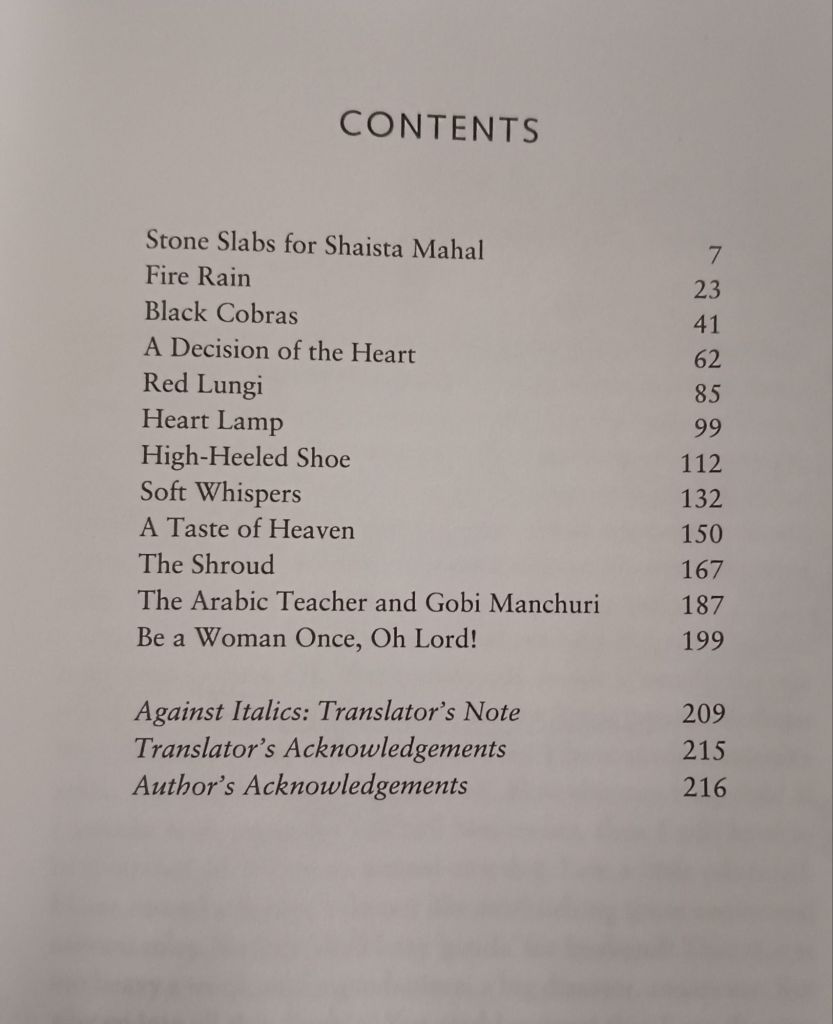
Heart Lamp collates 12 stories by a Karnataka-based writer, Banu Mushtaq, who is also a lawyer and activist. The stories paint an intricate picture of the Muslim community, sheathed in the orthodox customs and traditions, unjust and rigid at the same time, with women and children as victims. Mushtaq, through this book, critiques the issues of polygamy, keeping the girls bereft of education, household relations, women as a mechanism to bear and rear children and their desire to go for tubal ligation and the question of love. Through the stories, Mushtaq also unveils the various myths used by the male and maulvis to keep a check on women, to suppress them, to be more precise. Consequently, the stories present a largely patriarchal society. The gaps between the rich and the poor have also been reflected in some of the stories. This rebellious spirit of Mushtaq seems to come from her profession, i.e. an activist.
Mushtaq weaves her story in such a way as if you’re one of the viewers of the unfolding events. You feel the situation deeply, even though you’re apart from the community and the situations of the characters. I think this led the book to win the Booker- simple, honest, and unadulterated picturisation of a particular community. The rootedness and the deep experience of an author can be another aspect. The reference to Hindi and Hindu (Lakhshman Rekha, Ramayana, Mahabharata) aspects is an attempt to bridge the gaps between the two communities. The title of the book is actually the title of one of the stories. Evading responsibility is one of the key themes in the book, to which Mushtaq comments, “No matter how simple some things might seem, they’re not, or at least not always. People behave in strange and illogical ways when they’re afraid they may have to take responsibility” (2025, 187). The translator’s note and the author’s acknowledgement at the end of the book give us the first-person perspective.
The translator, Bhasthi, has kept her regional terms intact without italicising (justified at the end), which gives the feeling that it is a work of translation. Also, while reading the stories, you’ll feel disjunction in the usage of words, connectors and sentences at several points, which hints at the limits of translation. However, I still feel that the translations could’ve been better, including more regional words to build a strong connection with the audience. Also, folk songs and proverbs would’ve enriched the book.
I would recommend that the readers go through the book once and share their views in the comments. You don’t come across the International Booker Prize quite often, coming from the pen of an author rooted in India.
©Shashank
References:
- Mushtaq, Banu. Heart Lamp, trans. Deepa Bhasthi. Penguin, 2025.
 Pragmatic's Personas
Banu Mushtaq`s Stories are about sad poor women suffering in spite of doing their best to please their husbands. Or men around. God/nature has made women not only weak, but loaded the burden of childbirth, love for children and carry them as a committed burden. Men if good, have to bear double responsibilities and go for jobs too. It is not difficult for them as they are physically strong and “in Love” the burden is not a burden but a pleasure. this is roughly universal. A positive attitude of the writer would have been more impressive, if she had ended up her stories with somebody else coming to help the lady in distress. Real help, by a good person. These stories leave a very deep heavy burden on our minds. In real life as we read in news- papers worse things happen. But that is “News”. Indian movies were better! “Even Sholay”. Wonder why even the rules of our societies all over the world expect women to suffer and have no support for children. This has made reverse effect on women who are in better position. Freedom! Independence! Enjoyment! Cruelty, rudeness towards husband, and sometimes children is their fundamental right!
LikeLike