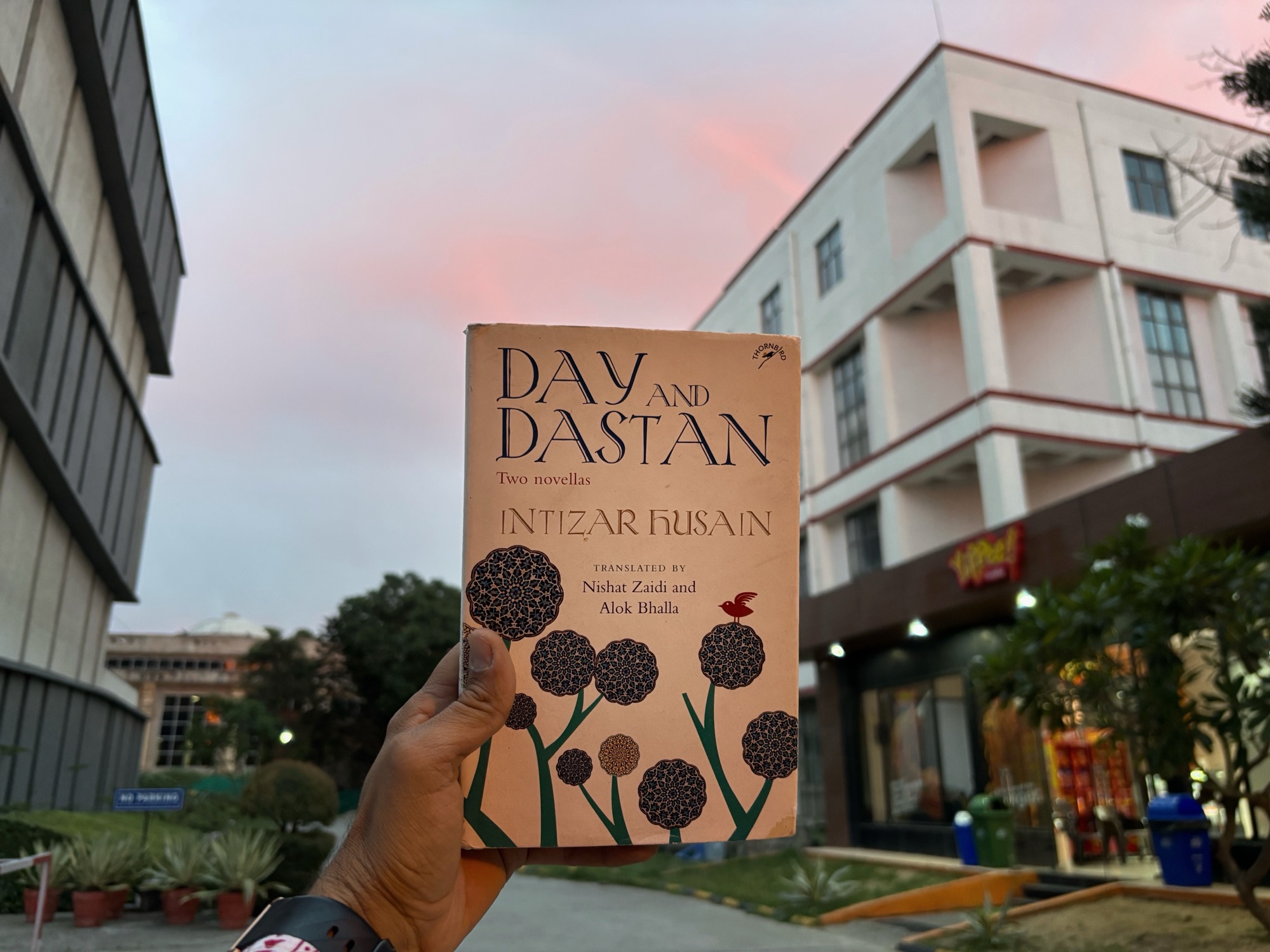

Without a story, we are bound to the immediacy of the moment, and we are forever losing grip on the reality of our identity with the passage of discrete moments. We are unable to speak of primordial or eschatological time.
-Charles E. Winquist
I was familiar with Hussain’s writing and his reflections on partition through his novel Basti (shortlisted for the Man Booker in 2013), which was part of my bachelor’s syllabus. Through this book, Day And Dastan, which collects two novellas into one, I once again got an opportunity to peek into the fragmented and dilapidated world of Hussain, caused by partition. He admits in an interview, “Explaining the experience of migration intellectually is a difficult task for me. I’ve been attempting to comprehend this experience through my stories” (Pray, 1983, p. 165).
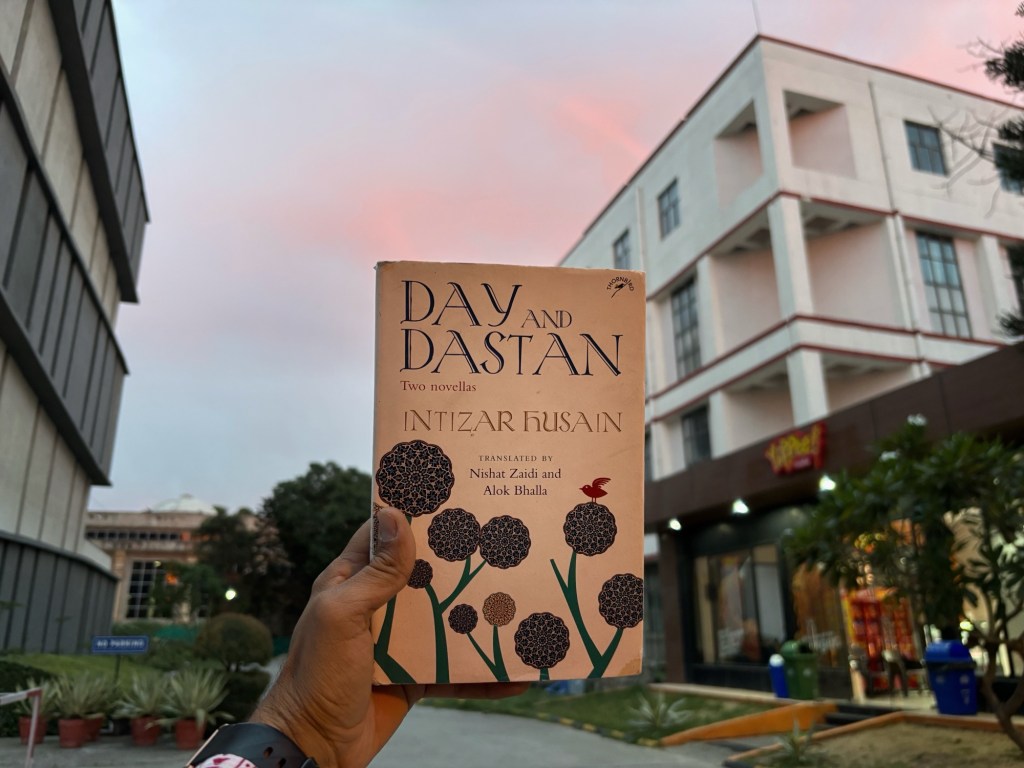
Title: Day And Dastan, Two Novellas
Author: Intizar Husain (or Hussain)
Translators: Nishat Zaidi and Ashok Bhalla (from Urdu)
Genre: Historical fiction
Publisher: Niyogi Books
Year: 2018
Pages: 190
Price: 311/- (hardbound on amazon)
The title is among the first aspects that draws me toward this book, which has been perfectly elucidated by Zaidi in the introduction. And I must say, the introduction part of the book is quite enriching. So, anyone beginning to read this book should ponder the introduction for some time before delving into the day, then Dastan. The ‘day’ runs into 88 pages (no wonder it’s called a novella), and the ‘dastan’ thereafter has several narratives in short-story format.
‘Day’ recounts the realistic tale of the partition from different lenses by the Muslim community whereas ‘Dastan’ employs myths, dream sequence, history and nostalgia to portray the series of events following 1857 revolt. Zaidi observes, “Unlike Din, which delves into the personal past and uses ethnomethodology in its efforts to make sense of the chaotic reality, Dastan connects disparate temporalities and spaces and blurs the line between the real and the fantastic, or history and fiction” (2018, p. 14). Both the novellas aren’t related but can read while placing it in the Indian history aftermath of colonial rule.
The events, familiar and repeated in ‘Din’, somewhat fails to grip the audience. At times, the story seems to move slow, to which readers loses interest at some point. In contrast, Dastan lures the audience to read further, since it embeds myth in the narrative and defamiliarises the audience. The rich depiction of nature is a trademark of Hussain, which is evident in both the novellas. However, it feels like it takes the reader away from the central plot at times. Several ‘urdu’ words have been left intact to retain the flavour of natural speech. This book also collects poems related to the series of events described in the book.
Altogether, this book is a work of fine craftsmanship in literature, since it collects the references accurately in the introduction, culminating in a glossary with two novellas sandwiched in between. It’s quite helpful to those pursuing research in this area and seeking primary or secondary texts. Others can also read to take a microscopic look at the lives and situation of people during partition.
Let me know what you feel about the book!
©Shashank
References:
Husain, I. (2014). Day and dastan. Routledge. (Introduction by N. Zaidi)
Winquist. CE (1974). “The Act of Storytelling and the Self’s Homecoming,” Journal of the American Academy of Religion 42 (1), 103.
 Pragmatic's Personas