
The play is not in the words, it’s in you!
— Stella Adler
An act is an important intervention in any play that determines its progression. The word ‘Act’ is derived from the Latin ‘actus’, which meant ‘doing’ or a part in the play. In Middle English, the same term is used with inflexion, i.e. acte. Modern English did away with inflexion, so ‘act’ became a standard unit.
An act and a scene are two different entities. You can read by my first episode on ‘Scenes’ from here. However, both act and scenes are defined better in relative terms. A scene is a subset of an act. A short pause within an act is categorised as scene. On contrary, an act is a longer intervention. In ancient times, the concept of act was introduced to give break to the actors, for refreshment and to refreshen. Since the play ran for a longer duration in those days, the duration for change in act was also considerable. Even audience had their food and join the performance. But nowadays, there is time constraint, the duration between two acts are comparatively less.
There is also a scientific reason for the change in acts. It indicates a change in the play’s plot structure or a turning point. For instance, a three-act play would consist of three stages. Exposition (setting up the story)–Intensification of Conflict–Resolution. However, in a five-act play, which was standard during the classical age, the plot would often progress through Freytag’s pyramid.
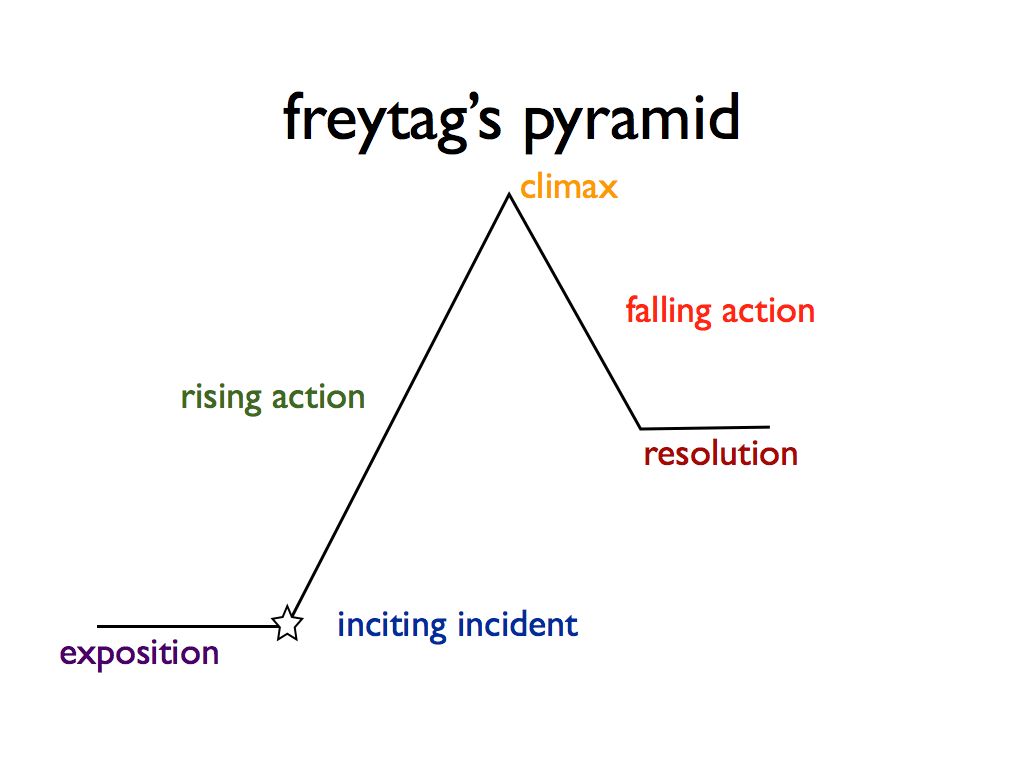
Interestingly, the Natyashastra by Bharata Muni and its commentary in the Dasarupakas by Dhananjaya elaborate on these five elements of dramatic progression as early as 200 CE. These elements that denote the Karyavastas are known as Arthaprakritis – the causations. For instance, (1) Bija – Germ, (2) Bindu – Prominent point, (3) Pataka – Episode, (4) Prakari – sub-story and (5) Karya – denouement. Though there were 10 types of drama as elucidated by Dhananjaya, Nataka and Prakarna were the most common forms. Nataka often encompasses heroic characters, kings and queens, and is usually based on an epic, whereas Prakarna was centred on ordinary characters and rooted in everyday life. Both types of drama usually consist of 5-10 acts.
The contemporary theatre is dominated by one-act plays. Hence, all the elements through which a drama progresses are woven into a single act. There is a 5-10 minute break, which can be considered a change of act. However, many play runs without any breaks. One practical way to change the act is to allocate more time to preparing the stage for the next set of events. It also happens after intense, dramatic actions to allow the audience to reflect on the next set of events that will unfold. When most of the characters exit, most of the props on the stage need to be changed, and the direction of the play changes, then one should consider changing the act. The change in act is also denoted by a blackout on the stage. Care should be taken not to make it too long so the audience doesn’t lose interest.
Let’s see an example of the change in act!
(Ending of Act I)
Several characters, with their jhola and jute bags, form a line and take a lap around the stage as if they’re migrating to another place. They are also led by crooked soldiers on both sides who are mistreating the people. Then they exit into the right wing of the stage one by one. A melancholy tune! When the last character exits, the light gets dim. The tune vanishes. Blackout on the stage.
ACT II
King’s administrative chamber. Several ministers are sitting on their designated thrones…..
©Shashank
P.S: Can you guess as to which play the last scene resembles?

