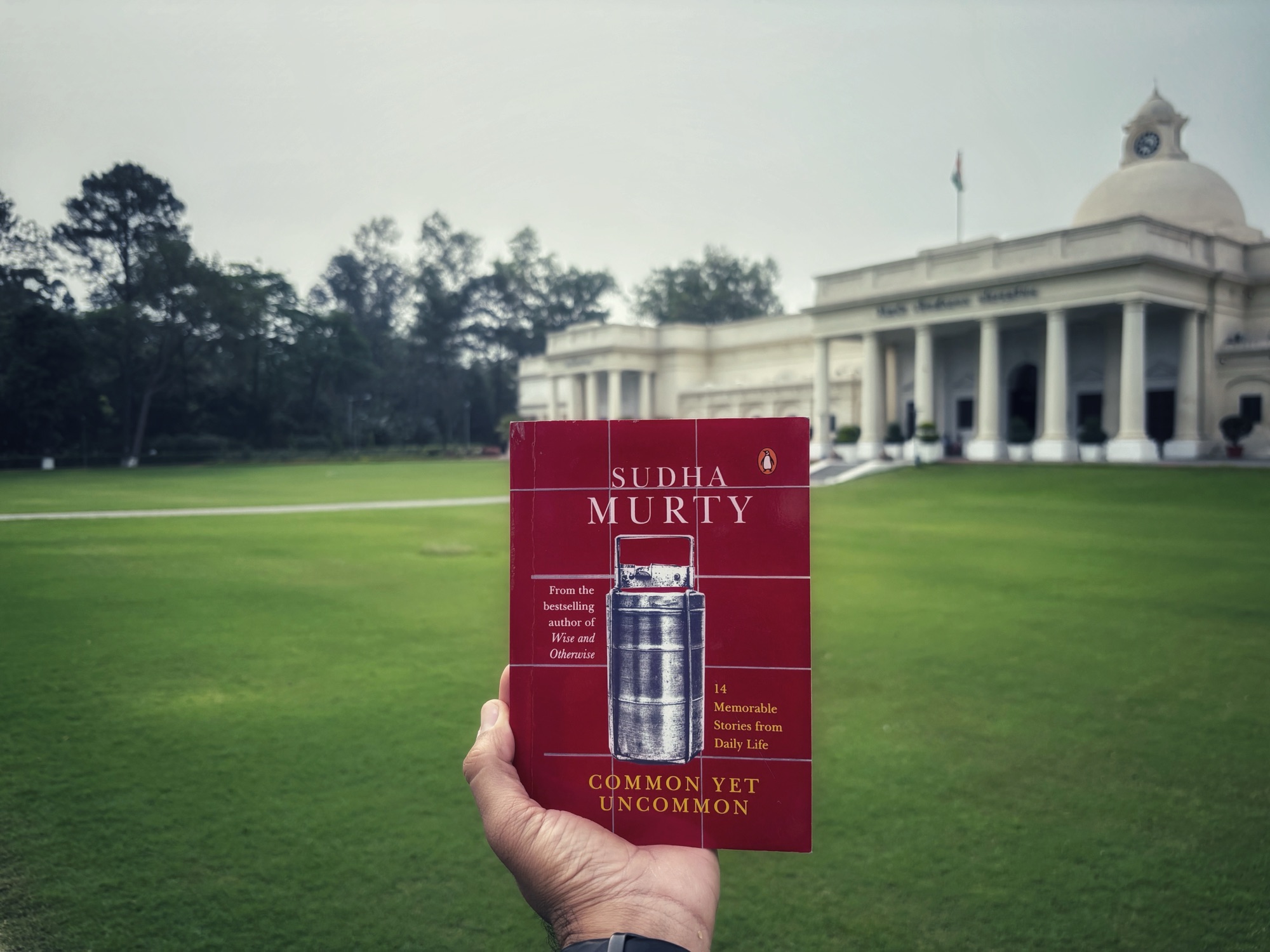

A Short Story isn’t just a genre but a feeling. Didn’t we grow up listening to and reading various stories and imagining them in different ways!
Murty’s writing style is quite natural and earthy, accurately capturing her experiences growing up amid the socio-cultural milieu. Before Common Yet Uncommon, I had already read two books, Three Thousand Stitches and Wise and Otherwise, authored by Murty. Her short stories, even in English, read with a natural flow. She largely draws on her experience (I must admire her keen observation) of her community, college, offices, and society to construct her weave her story. Let’s see how common or uncommon this book is!
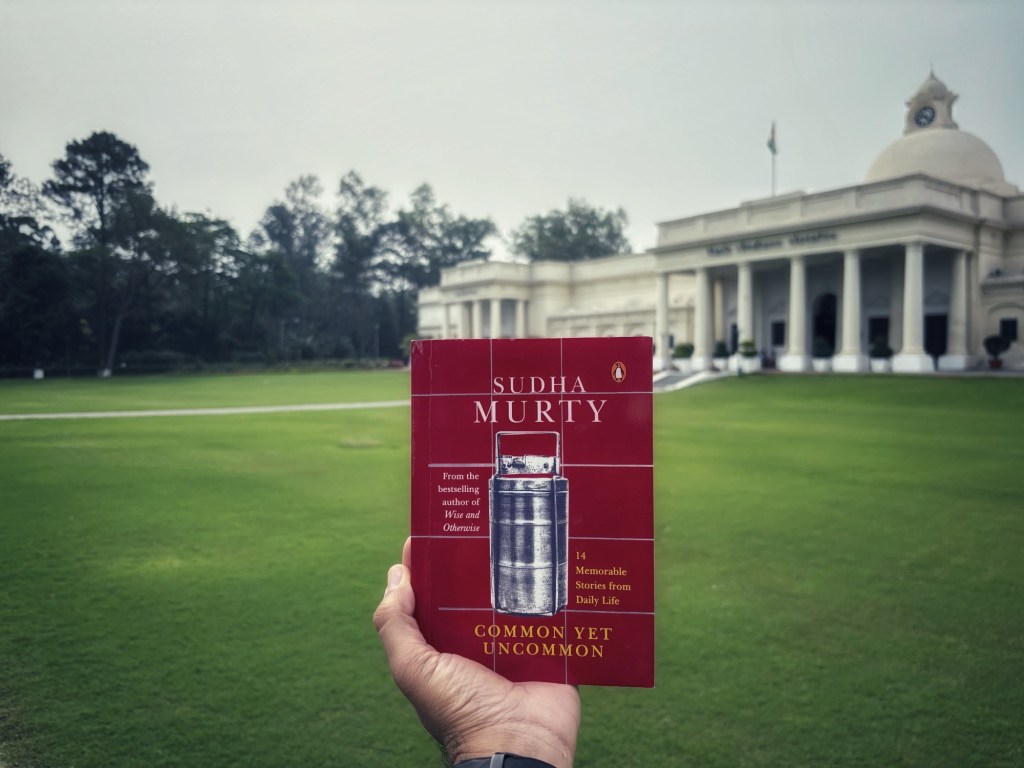
Title: Common yet Uncommon
Subtitle: 14 Memorable Stories from Daily Life
Author: Sudha Murty
Publisher: Penguin Random House (2023)
Genre: Short Stories
Pages: 182
Price: 251/- (amazon)
The book collects 14 stories centred around Karnataka, which also includes a preface and an epilogue. Murty highlights the hybridisation of culture, food habits and language, particularly in Karnataka’s northern region. She reiterates the statement, “No wonder it’s said for every 150 kilometres that you travel in our country, you will see a change in food habits and dressing style” (p. x), which delineates the widespread diversity in our country. However, I feel that the ‘kilometres’ thing keeps changing. I also saw somewhere that it changes every six miles. So, let’s avoid the technicalities and understand the essence.
The remarkable feature of Murty’s book is the world she weaves and the way she places her character. Her character behaves as a character would in such a setting, thus reflecting a perfect social situation. She portrays them without any extra makeup. She observes, “These people have a transparent mind and are outspoken. They are not polished, neither in their speech nor in their appearance” (p. xi). It helps the reader delve deep into the individual’s life and its intricacies. Murty’s characters aren’t very revolutionary, but they have the consciousness that they’re being wronged. It is their struggle that she captures accurately.
Common yet Uncommon deals with a locality or colony in North Karnataka, where different types of people, engaged in different occupations, live. This statement may appear true for any locality, but what is unique is Murty’s attempt to locate uniqueness in their life. She admits, “These people were not famous- neither did they get any recognition in society, nor did they crave it. Yet, each one is unique” (p. x). The book weaves a close-knit community, with a couple of characters (for instance, Nali) recurring across several stories. Even if they are not present, they are referred by the characters in the story. They act as a thread, a sutradhar, making the audience feel they are part of a community.
It is not possible for a writer to weave all the stories of a similar magnitude in a collection. In this collection, some stories are more engaging than others. I was fascinated by Jayant the Shopkeeper, Jealous Janaki, Not Made for Each Other, Miser Jeevraj, Sharada the Fortunate and Lunch Box Nalini. The other stories also offer an engaging reading. Hence, anyone looking to revive their reading skills or cut screen time should start with a short-story collection. This book offers a lucrative starting point.
©Shashank
References
Murty, S. (2018). Common yet uncommon. Penguin Random House India

