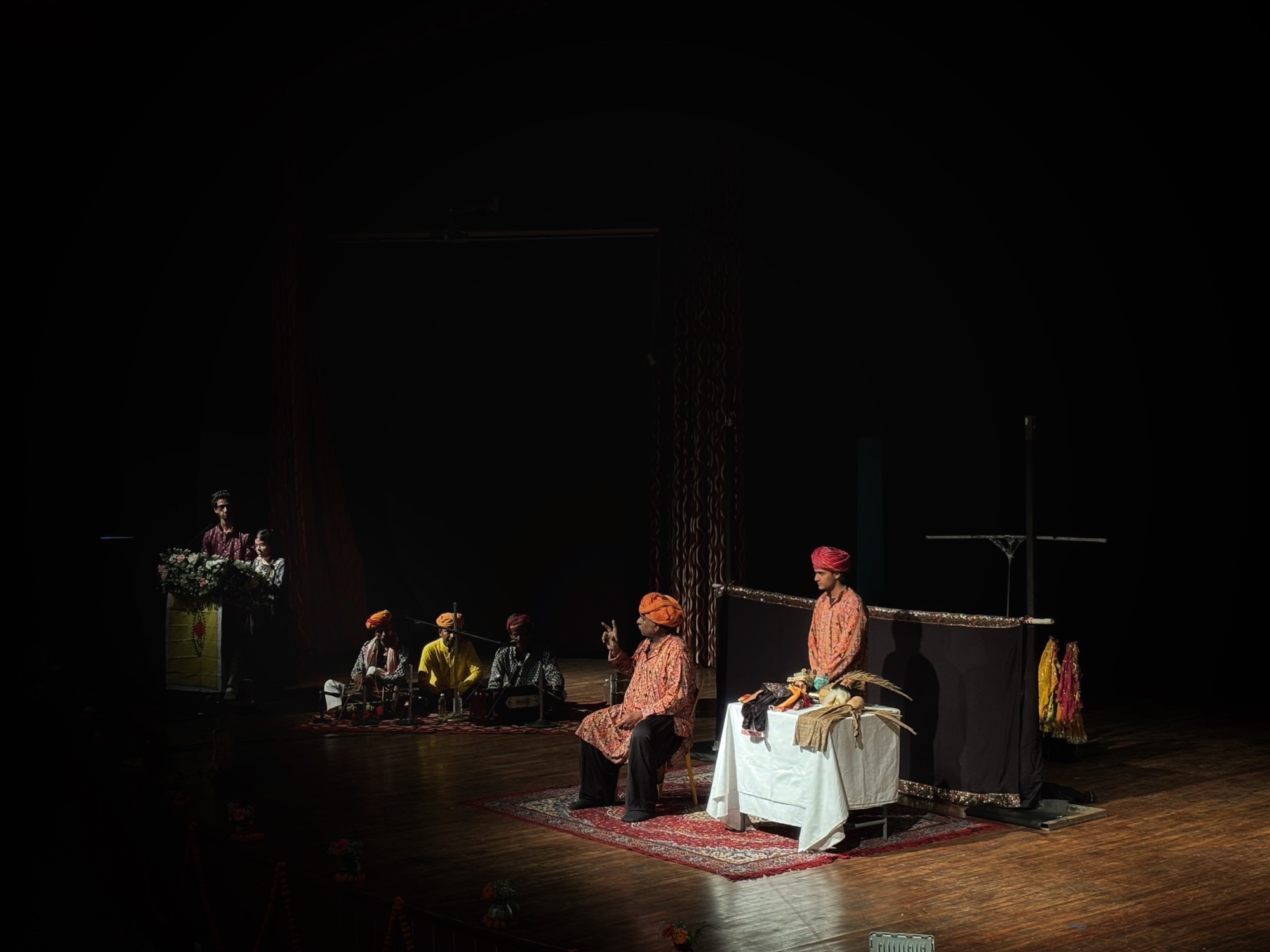

There is a strong connection of human with puppets. For sometime, it may appear that we’re controlling the puppets but in real, the puppets control us!
Another evening. Another SPIC MACAY event. Another Puppet Show. And this time, a Sangeet Natak Akademi awardist, Shri Puran Bhat ji on the show. I had the opportunity to witness two puppet shows earlier on the campus: ‘Shadow Puppetry’ by Shri S Hanumanthu and ‘Human Puppets’ by Shri Dadi Pudumjee. I have already covered Pudumjee and his puppets (link embedded) in my earlier blog post. Let’s see what story Bhat ji’s puppets have to tell!
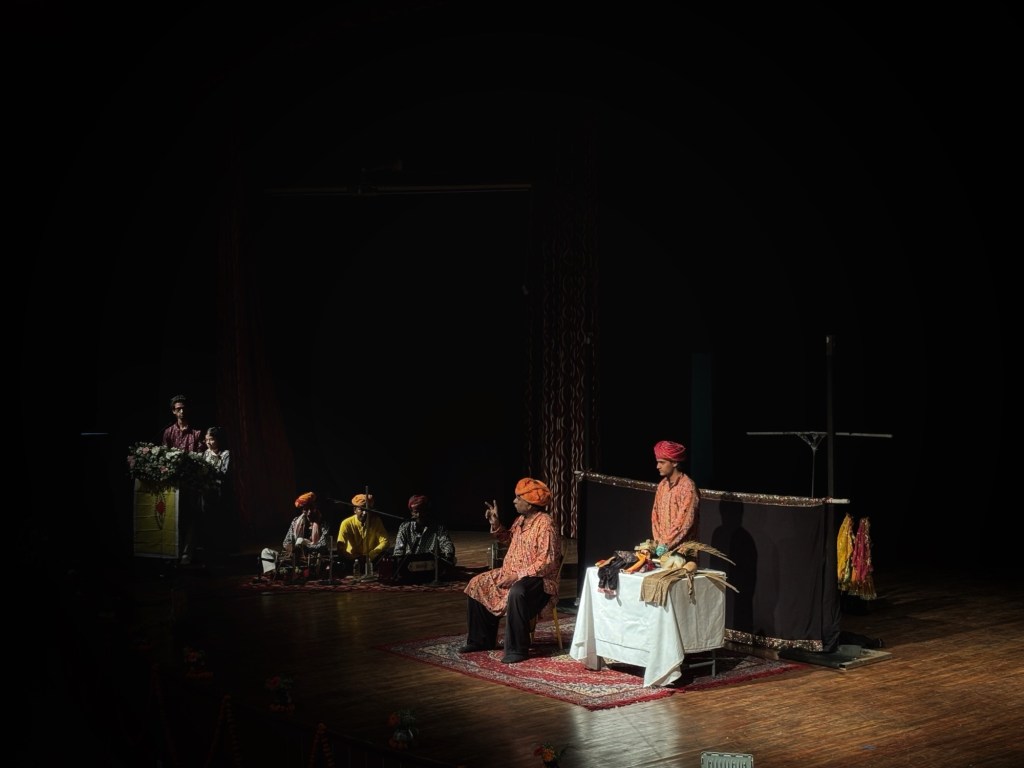
As is customary at SPIC MACAY cultural events, the show began in a conversational style, with Bhat ji asking and answering questions about the history of puppets and how puppetry, as an art, came to be part of tradition. He then elucidated the various kinds of puppets (based on the way they’re handled), such as String puppets, Glove puppets, Rod puppets, and Shadow puppets, while demonstrating how they are performed. You can see the different kinds of puppets in terms of structure and shape on the table in the picture above. I was delighted to discover the variety of ways in which puppets can be handled and the range of emotions they can convey. However, as Bhat ji conveyed, puppets don’t have emotions, and his lifelong quest had been to portray emotion through puppets.
After the demonstration of different types of puppets, it was time for the much-awaited show. I thought that puppets would perform behind the arch, the black cloth, as you can see in the picture above. But to my surprise, Bhat ji and his team brought the puppets before the manually constructed arch for the performance. We could peer at the calculated, precise hand movements of the puppeteers, along with the complete view of the puppets. All the actions happened on the carpet in front of the arch.
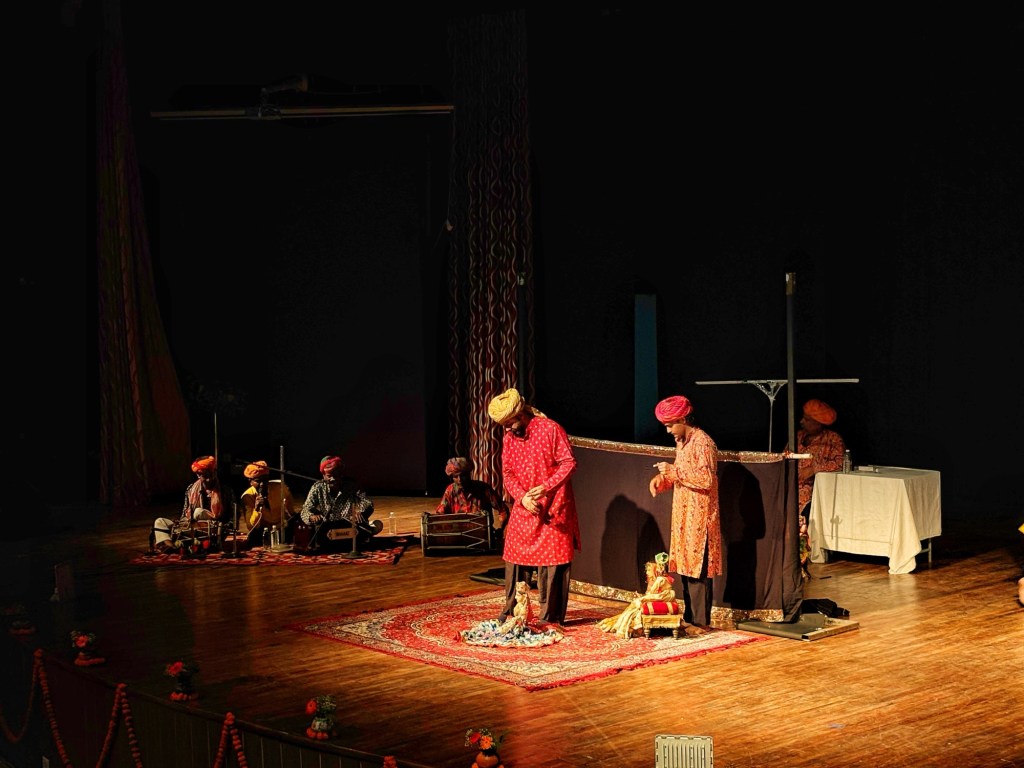
The theme of the puppetry show is usually historical or mythologically rooted in tradition and culture. In this performance, a king returns to his court after his marriage. On this occasion, the villagers (here, puppets) performed the art they were proficient in. For instance, a horse rider, a girl swinging a ball, Anarkali and others. They started their performances after greeting the audience, the king and the queen. One remarkable aspect of some puppers was that they embodied both male and female genders in one. Bhat ji flipped the puppet upside down to change the gender. It minimised the number of puppets while offering a smooth transition. However, when both genders are needed simultaneously, then there will be a need for two separate puppets. The show, though it lasted for less than fifteen minutes, was full of fun. A great number of the staff’s children actively participated and engaged with the show. Contrary to what I wished, the show was called off without any plot or twist. The childhood days returned, I would say. After this show, some more puppets were introduced, such as muppets and human puppets (in Dadi Pudumjee’s show). One of the memorable moments was when they all came down the stage to shake hands with the audience.
Music was one of the crucial components of such a performance. As you can see in the picture, there were four musicians in the group, two on dhol, one on vocals and one on harmonium. Besides, Bhat ji has a specially designed mouth organ that he uses to produce sound at heightened moments during the performance. I also felt that a part of the sound is already recorded, and the performance is timed according to it.
At the end of the show, there were Q/A sessions. One of the elderly female participants expressed concerns about taking the puppets out of the curtain and into the open. She argued that she was distracted by the hand movements and couldn’t focus on the puppet’s actions. While the question was apt, Bhat ji replied aptly, saying that this form is an improvisation of the traditional puppetry. Art demands uniqueness. If an artist is renowned today, it is because of their ability to provide a unique experience to the audience. It offers him the opportunity to experiment with puppet sizes to present emotion and action in greater detail. I also believe that art should be innovative and improvised in changing times to remain relevant while catering to modern audiences’ tastes. Personally, I found the movements of the hand controlling the puppets intriguing. Ask yourself this question: Would you visit a place twice to see the same puppetry show? The idea is to preserve the soul of the traditional while embracing modernity. I also asked, “Where can I go to watch your full-length performances?” Bhat ji said that it’s not fixed. He performs on demand and incurs high setup costs, adding that he can also perform here. For that, I have to get permission from the faculty advisor, I replied humorously, and the audience started giggling.
The show came to an end with the felicitation of the artists. We left one by one after an hour of diving deep into the world of puppets. I felt reluctant to come out of it into this world, where certain responsibilities and situations awaited me. Only if I could avoid. Here are some of the clips from the show: Puppetry 1| Puppetry 2| Puppetry 3
©Shashank
P.S. Thanks, Shivangi, for accompanying me and making the show even more enriching.

