
Simple living, high thinking– the statement is justified when you peep into the life of a writer!
As I delve into my memory of school days, I remember delivering a speech on the birth anniversary of Munshi Premchand. Since I used to practice several times, some lines, though in fragments, had been etched in my memory since then. It includes his original name, Dhanpat Rai, his village, Lamhi, where he was born and brought up, and the names of some of the novels and short stories he composed. I must say, I grew up reading Premchand’s short stories and also dared to pick up his novel ‘Godan’ later on, since I was fascinated by the picturesque worlds he used to weave and his portrayal of characters in them- earthed, rooted and realistic. Premchand stayed with me even during the college days. In bachelor’s, whenever any teacher would ask my favourite writer, I would reply Premchand, since I read him more than any author at that time. Luckily, the DU English Honours syllabus has an optional paper titled ‘Modern Indian Writing in English Translation,’ amidst a bulk of British Literature, which I opted for without any second thought. And guess what! His story, Kafan, came back again to me in the form of The Shroud, translated by M. Assaduddin. After two years as a student of English literature, and re-reading Kafan, I was surprised by the multiple voices and directions the story could offer. That’s when I felt the grandeur of Premchand. Since then, I’ve only heard and believed.
The story of my encounter with Premchand reverberated once again when I found his village, Lamhi nearby the place where I went to attend a function in Varanasi. It’s my habit to scroll through the maps and read the signboards wherever I go, and that’s how I discovered his memorial in his village (exact location hyperlinked), which was around 3 km from the place where I was residing.
Timing: 11 AM- 6 PM
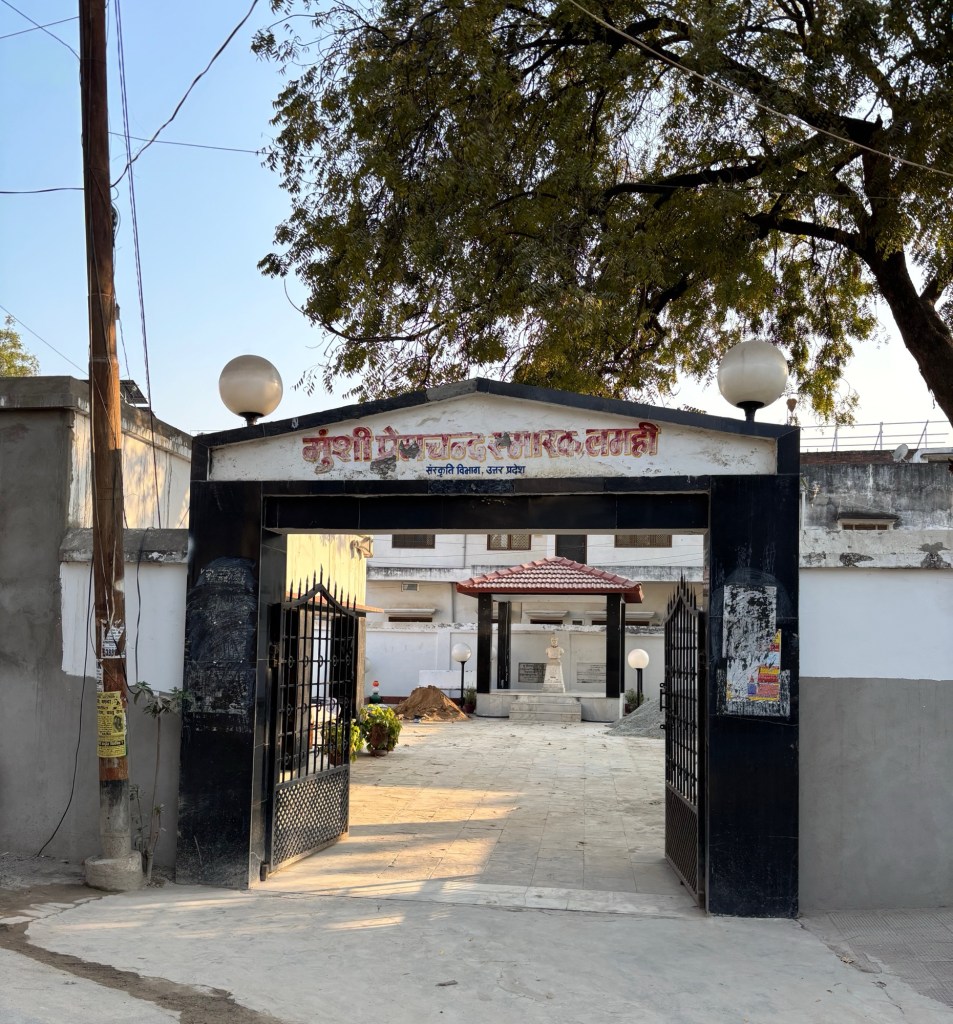
Before Rapido wale captain cum bhaiya dropped me here, he asked multiple questions related to Premchand and his writings. The question that hit me the most is, “Why doesn’t any writer in today’s time write as well as Premchand did?” I became clueless for some time. What do you think I would have replied? Also, according to you, what can be the reason?
There are two rooms on the left side of the entrance, where the books and belongings related to Premchand are kept. Among them, there were some hurricane lamps, plaques, a portrait of Premchand, a picture of gods and goddesses, a telephone and multiple shelves, stacked with Premchand’s books and those of other writers. The upper section of the wall has been decorated with posters featuring his popular stories. Both rooms were under renovation, hence the stuffs were lying hither and tither.
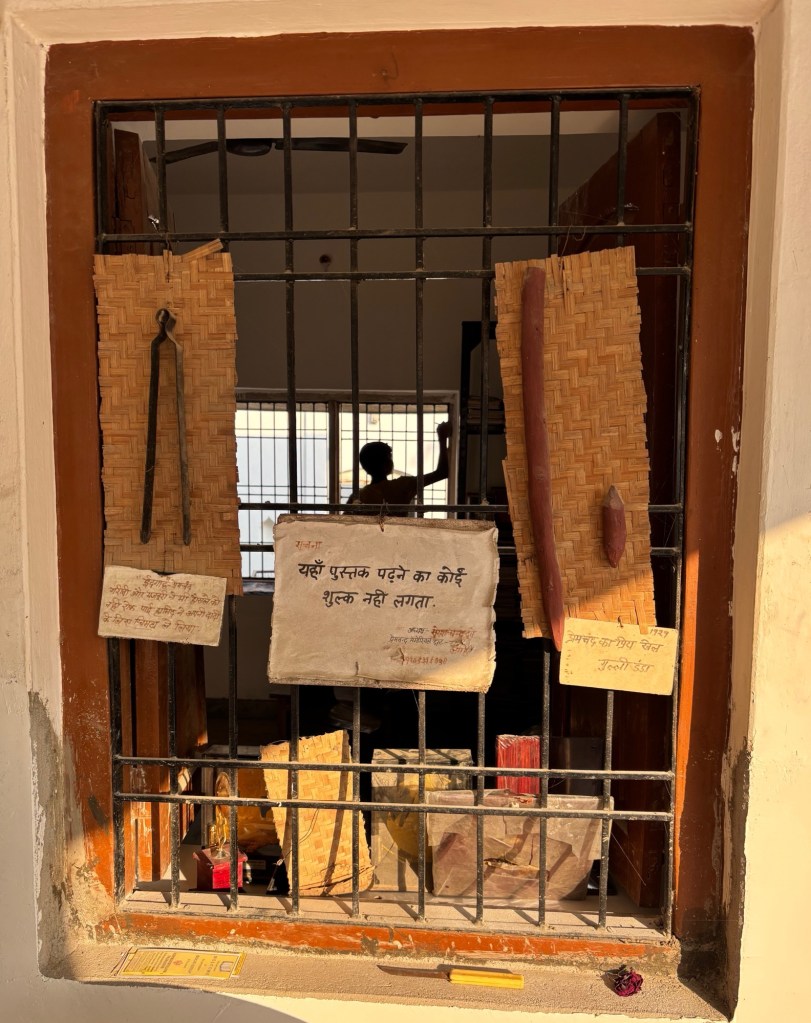
If you peek through the window above, you can locate a guy who was painting the grills of the window. I tried asking him a couple of questions, but he didn’t seem to take any interest at all. “Does Premchand matter to him? Or his works? Or even literature?” I thought for a while, “What’s the use of writing for someone who doesn’t even read?” Premchand wrote extensively about the marginalised section of society; however, I wonder how many of them would have read him? At such a point, I question the purpose of literature.
The second room was empty as all the books and stuff were taken out to clean it. Even the memorial was under-construction as I could see concrete, sand, and cement lying nearby. I came out of the memorial and strolled further. I was surprised to see Premchand’s abode just beside his memorial.
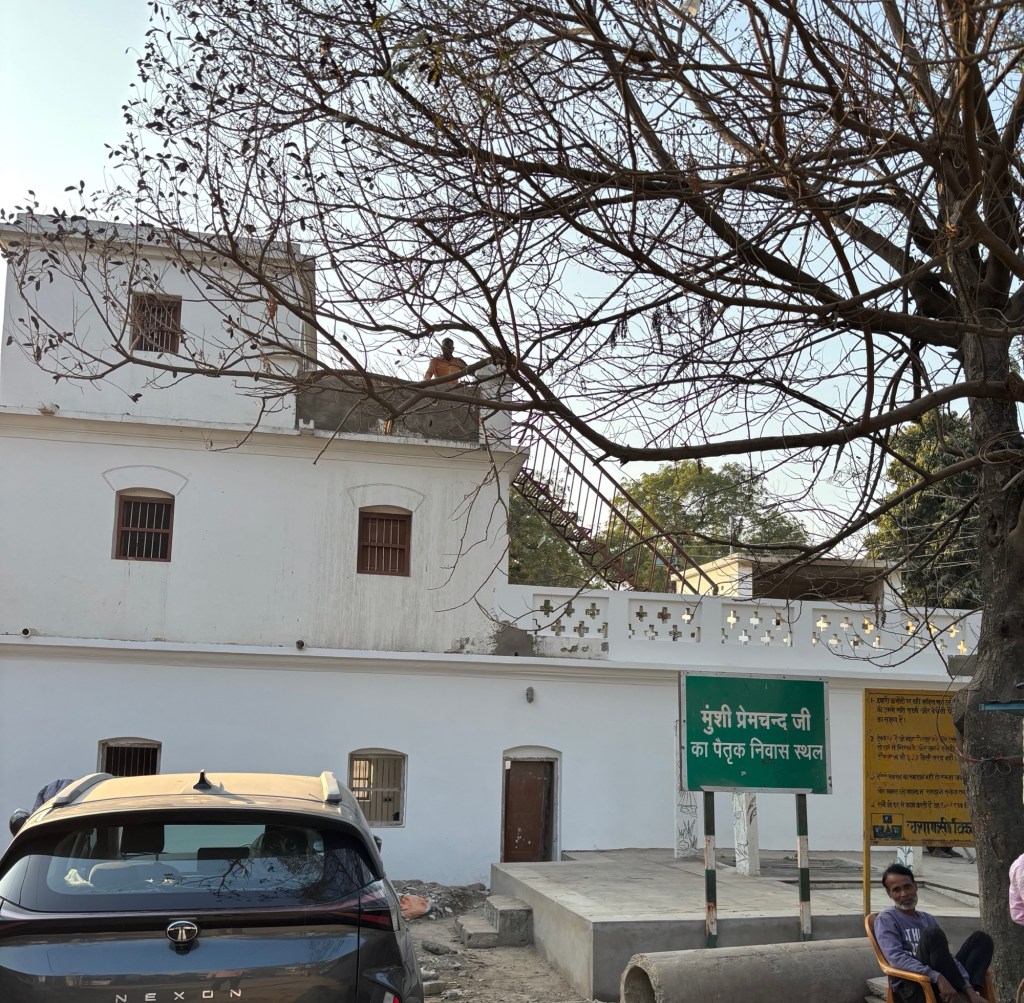
So it’s here, Kalam ke Jadugar was born some 146 years back. I don’t know how much of it has been renovated, but when I visited, it was still under renovation. On peeping inside, I found that it’s empty. On enquiring whether someone still lives here, the uncle who is sitting near the signboard said that the property has been taken by the government, hence nobody is allowed to reside.
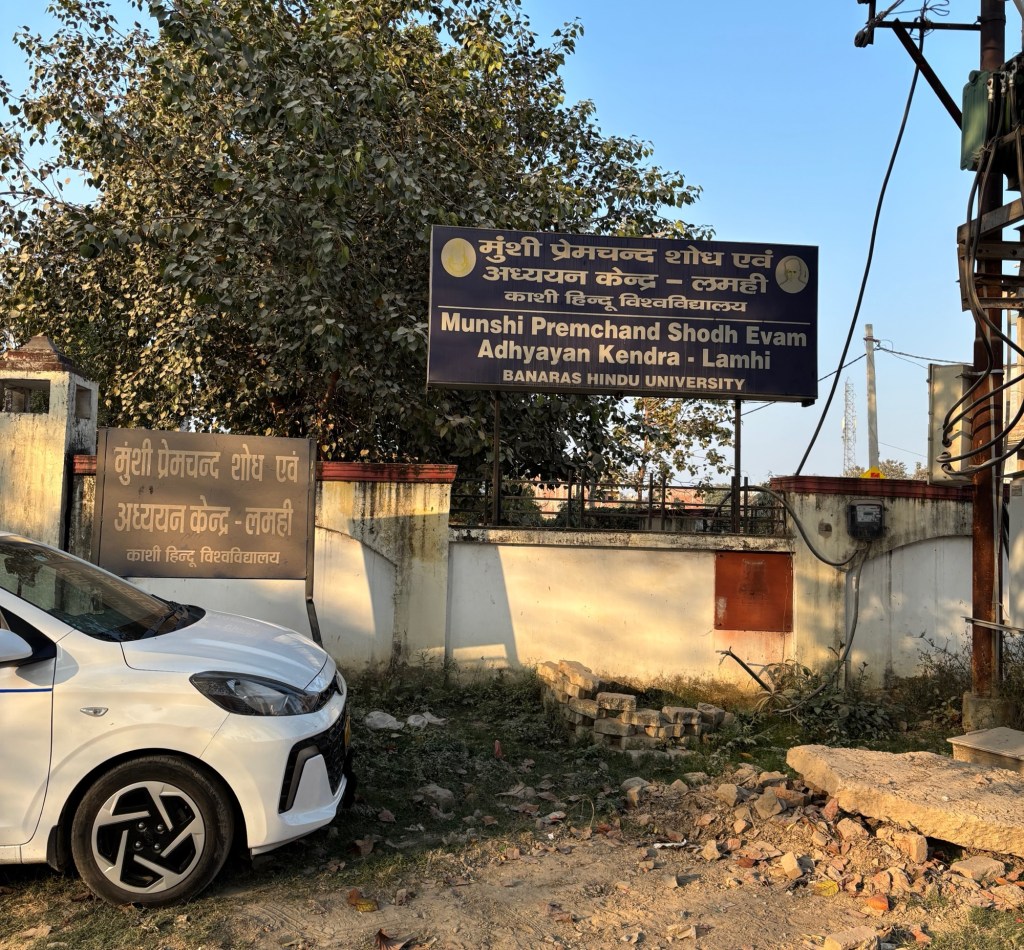
But to my surprise, there wasn’t any centre or academic building as such dedicated to research on Premchand. All I could see was the piece of land with a fence around it. I again turned to the same uncle. He said, with a dismissive tone, that kabhi start nhi hua ye (It never started). However, on the right side of this land, a temple was under construction.
Thus, Premchand, whose work has touched several hearts and is placed in several corners of the world, started from this house, situated in a village named Lamhi. I’ve already asked Rapido Wale Bhaiya to wait for me as I take a look, since I was afraid I won’t get any mode of transport back to the hotel. Gladly, he was waiting for me near a pond near Premchand’s abode. I am still clueless as to why he didn’t come with me since he showed keen interest in Premchand! Let me know your views in the comment box.
Also, I can state with certainty that the next time you’ll be visiting here, the place will have something more to offer, since both his abode and his house were under renovation at a rapid pace.
©Shashank
P.S. To make your visit multipurpose, you can also check out the Trade Facilitation Centre & Craft Museum, which is only 1 km from here.
 Pragmatic's Personas