
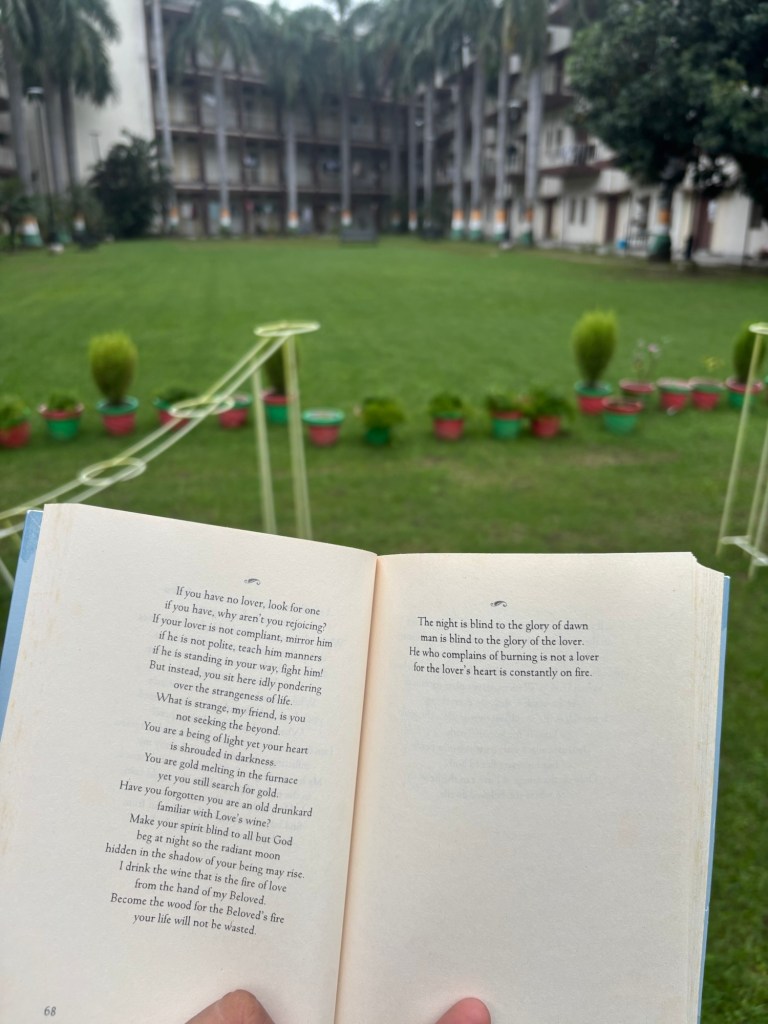
The night is blind to the glory of dawn
man is bind to the glory of the lover
He who complains of burning is not a lover
for the lover’s heart is constantly on fire!
– Rumi, p. 69, 2024
Whenever I need to revive my reading skills, which are partly lost to the academic workload and partly to my mobile phone, I turn to a book of poetry. Let’s put it this way: when life starts to appear prosaic, it is the poetry that offers solace. I remember writing my last book review in May. Since then, I have read books, but not enough to write a review. Feeling guilty of my waning reading ability, I decided to go for a shorter version, such as a graphic novel or a poetry collection. I remember once a friend of mine showed me a poetry collection. I immediately asked her if she could lend the book for a couple of days, to which she happily agreed. And that’s how I came across Rumi, a Persian Sufi mystic poet.
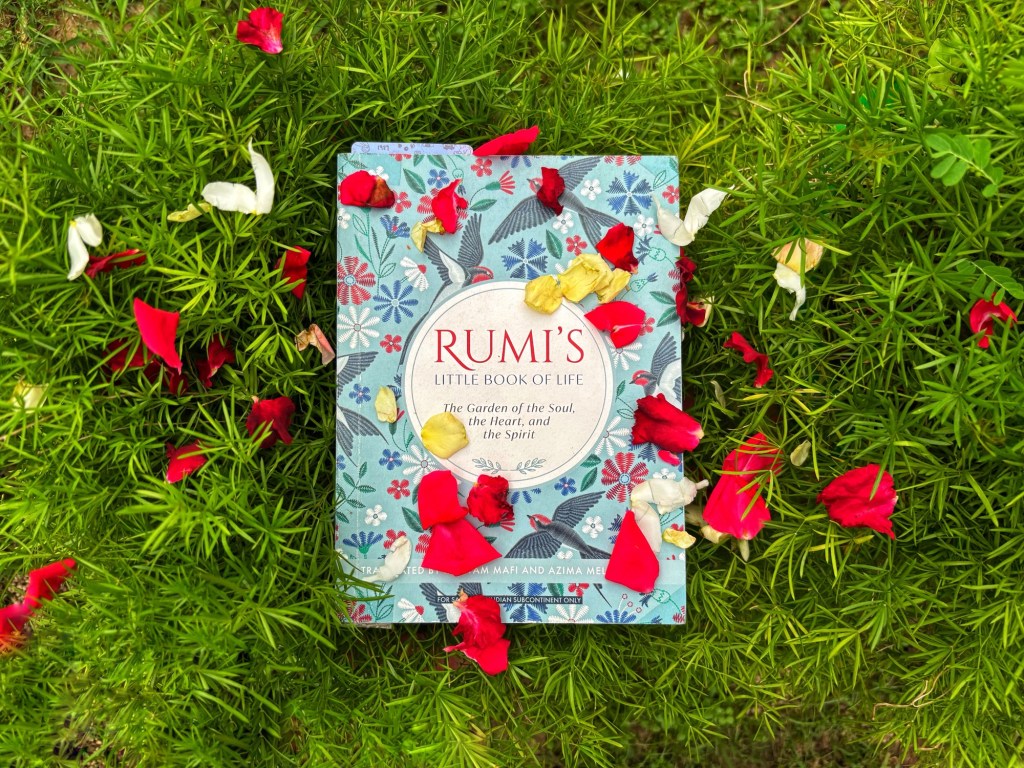
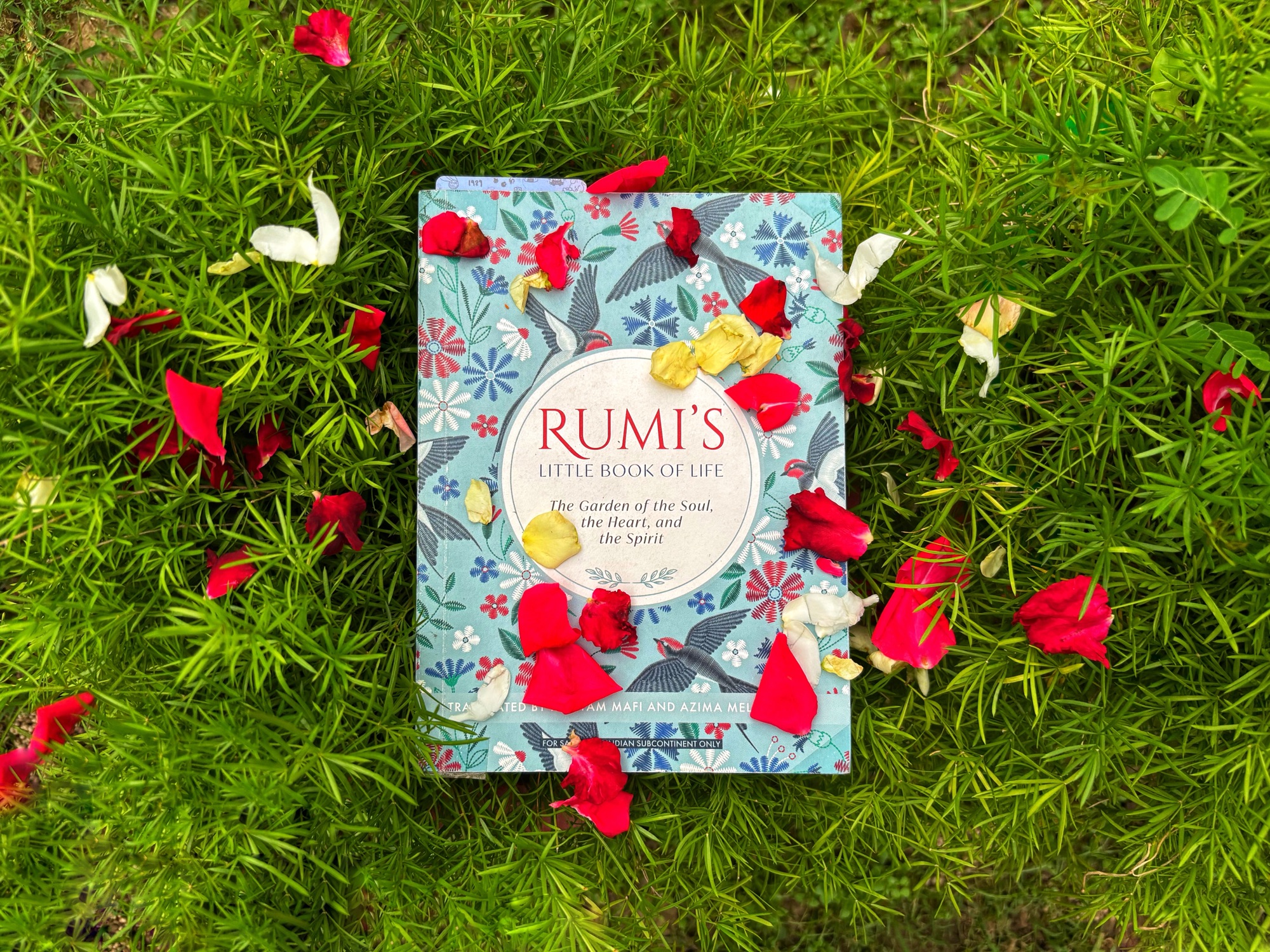
Title: Rumi’s Little Book of Life
Author: Jalāl al-Dīn Muḥammad Rūmī
Language: Original Persian; Translated in English by Maryam Mafi and Azima Melita Kolin
Genre: Poetry Collection
Publisher: Amaryllis (Imprint of Manjul Publishing House)
Pages: 203
Price: 237 at Flipkart
At a time when poetry’s readership is declining, it is crucial to revive and establish its contemporary relevance. Translating it is one way to introduce the book to diverse languages, cultures, and traditions. When the translation is in English, it facilitates the worldwide readership. However, the translation of poetry isn’t as easy as it seems. Some scholars have rendered the poetry as an untranslatable entity. I don’t disregard the possibility of translating poetry; however, I am skeptical of achieving faithful or impactful translation. There is an utmost need to uphold the soul (the actual meaning) of the poetry. Upholding the rhyme and meter comes later. Thus, a translator engaged in poetry translation should cater to the multiple aspects while rendering it into the target language. This is why I prefer to read the translator’s note/foreword for every translated work to gain insight into the translator’s choices. Luckily, in Rumi’s Little Book of Life, there is a forward, not by the translator but by Narguess Farzad, a senior fellow in Persian at the School of Oriental and African Studies, London, which offers crucial information about Rumi’s work in translation.
This book collects around 200 poems into three sections: The Garden of the Soul, The Heart, and The Spirit. The poems are around a stanza to a page long. These poems evoke themes of life, love, spirituality, and nature in subtle yet impactful ways. The poem does more than awaken a person’s conscience. It connects the person’s inner self to the spiritual. Rumi also talks about intoxication, but his idea goes beyond inebriation from wine or whisky. The theme of love is profound in the composition. The poet longs for his union with his beloved in varied ways. At the same time, he warns against its counter side. The poems are also rich in similes, allegory, and metaphor, which further enhance the reader’s imagination. The poem can also be read as a deep meditation on life. It also mirrors the very issue the human is seeking escape from.
Indulging our pride, we run after
every fleeting image
How odd that being so unimportant
we cultuvate such grand illusions. (Rumi, p. 3, 2024)
Since I haven’t read the original work because I don’t understand Persian, I can’t detail much on the translation. However, I felt I was able to grasp the emotions and imagery portrayed by the author in the translation. The transition from one stanza to the other, or one line to the other, is also quite smooth. However, I don’t see much engagement with rhyme and meter in the translated one. At several junctures, I felt the utmost need to read it in the original. The inappropriate punctuation is retained deliberately to emphasize the word and mark of the texture of the translated work.
If you’re looking to read something deep as well as light simultaneously, grab a copy of this book. Reflect for a while after you’ve read a poem. That’s how you’re going to make the most of it.
©Shashank
P.S. Thanks, Shree, for lending this beautiful collection.

