
Have you watched a play in the language alien to you? How do you record your feelings?
Any play should be rooted in your socio-cultural and linguistic landscapes to comprehend them aptly. But if that’s the case, how would we know the developments (in terms of culture and technology) happening in the theatres of other regions? Even if you adapt to your native landscape, you not only change the language but also the cultural and social contexts. To overcome the language barrier, a performance is usually aided by technology. ‘Surtitling’ is also a way to understand performances in alien languages. However, it has its own challenges. During the 2026 Bharat Rang Mahotsav at the National School of Drama (NSD), I had the opportunity to witness one such play in Russian.
Title: A Very Simple Story
Director: Prof. Alexey Blokin
Running Time: 120 minutes (Around 2 hrs)
Theatre Group: GITIS Russia
Language: Russian
Genre: Romantic Comedy, Melodrama
Theatre: Abhimanch Auditorium, NSD
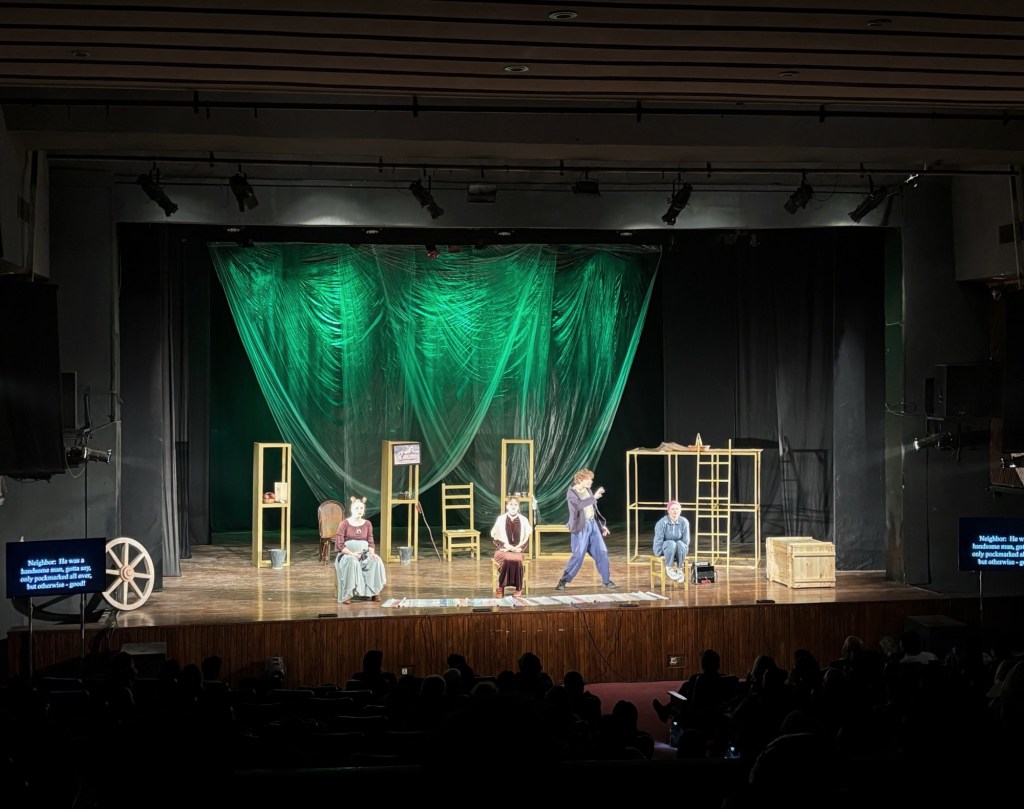
Pantomime is a dramatic form in which actors communicate through action, movement, and expression. It is designed so that reliance on dialogue is minimal, and the audience understands the play through its physical vocabulary. However, to comprehend a play that is not a pantomime through action appears to be a difficult task. I realised it twice. First, when I watched an Assamese play in the same auditorium last year and second, in Russian this year. However, there is a nuanced difference. The latter was assisted with surtitle- a screen displaying the spoken dialogues. I suggest that you once view the above picture to locate a digital screen on either side of the stage. If it’s not automated, a person manually shifts the dialogue through their system. That person is expected to be fluent in both languages. I believe it’s an innovative way to help the audience understand what’s happening on the stage. However, the problem is focusing on two spaces simultaneously. If you try to figure out the dialogue while viewing the screen, you would miss the action and if you focus on the action, you would miss the plot. That’s what happened to me. I was trying to focus at both the screen (since it was placed in the corner of the screen) and the stage and eventually, I ended up missing the both. Also, I was sitting at the back, hence, the sentences on the screen were not visible clearly. Since the actors have a pace to maintain, the surtitle used to shift before I could read. To overcome these restrictions, either I suggest to enhance the screen size and its placement in the theatre so that switching between dialogues and actions become easy. Introducing voice-over could be another way to address the audience simultaneously with the action.
Now coming to the play, A Very Simple Story is not that simple. Even the props on the stage appears to be simple but in real it’s not, since it’s should be crafted in such a way to handle the weight of 2-3 actors, since then and now, they would ascend on it to escape from family members. The whole set up appears a space in rural area. There is a large box from where characters will take out props now and then and sometimes, hide in them as well.
The play is reminicient of Romeo and Juliet, except the royal setting. In this play too, a girl and a boy fell in love against the wishes of their family members, especially the girl father who is often called ‘master.’ He is the patriarch in the family and resist in every way to keep the girl away from the boy. Many of you might be wondering that if the play is based on realism, why have I called it a melodrama! It’s due to the heightened action they display on the stage. At times, the energy and the moevement across the stage is swifter than usual, which we don’t generally come across in Indian plays. The colour changes and with the scenes and diffises through the plastic hanging from the back. Another important aspect of the play is allegory and dream-sequencing. Animals are often humanised and a character dress as an angel and reflect her innermost wishes. Click here to view a scene in the play to get some idea.
Surtitle aids the play but can’t replace it. It’s there to assist you. Also, a play in the language other that you’re well-versed in test your comprehending skills as an audience. At such time you turn into an active observer rather than staying a passive audience. I know I couldn’t make much of the play, nonetheless, I got a range of experiences, not limited to dialogues. Hence, I suggest you to explore plays in diverse genre, language and region to see the innovative practices, techniques and themes.
Let me know if you’ve more queries or suggestions.
©Shashank
Disclaimer: All content and images on this blog are protected by copyright and are the intellectual property of the blog owner, unless otherwise stated. Unauthorised use, reproduction, or distribution of any text, images, or other materials without permission is strictly prohibited. If you wish to share or reference any part of this blog, provide proper credit and include a link back to the original source.
 Pragmatic's Personas