
I welcome you to the second episode of Theatre Games. In the previous episode, I discussed five theatre games: Zip, Zap Zop, Name and Gesture, Pass the Clap, Passing the imaginary ball, and Shake Down. I advise you to become familiar with it if you haven’t visited it yet; click here. I’ll continue our discussion of the remaining five theatre games in this episode, with special emphasis on how these exercises can help develop children’s listening skills, confidence, and imagination.
6. Walking in Space
This is a simple yet impactful activity that, when done appropriately, develops important theatrical and interpersonal skills, particularly spatial awareness, concentration, physical awareness, observation, and ensemble coordination.
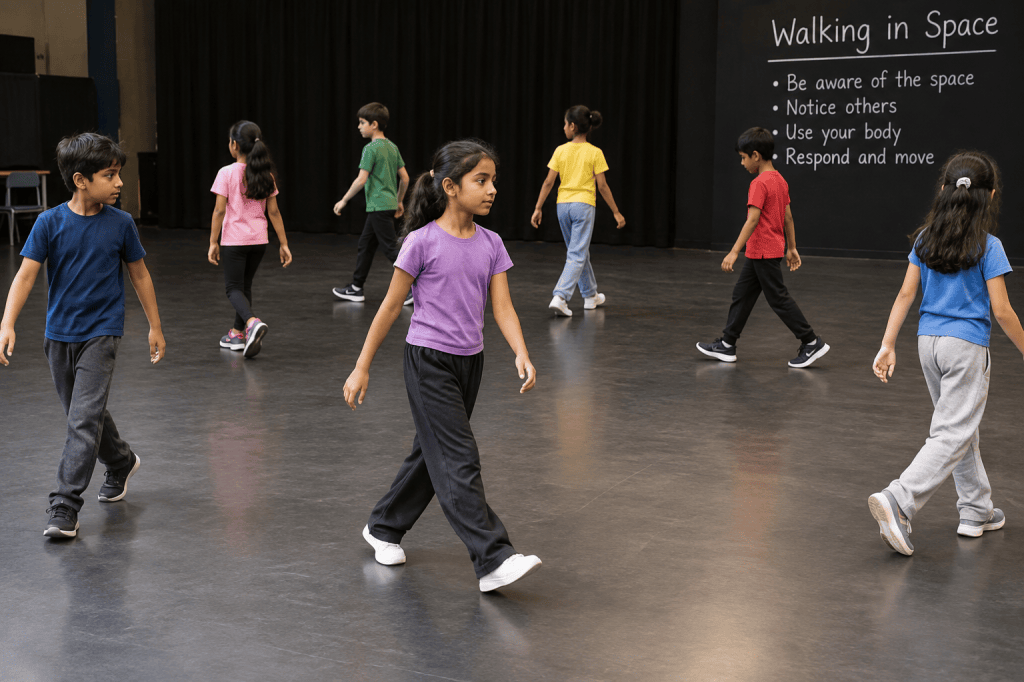
Steps to conduct this game:
- The participants spread out across an open space.
- They should walk naturally, without following a particular person or forming a circle, while remaining conscious of their surroundings, including the people around them.
- In between, the facilitator can gradually introduce instructions such as: Change direction; Walk faster or slower; Stop suddenly; Change your posture; Walk as if you are happy, frightened, tired, or angry; Walk as an old person, child, soldier, or royalty.
- Freeze when the facilitator says ‘stop.’
- Eventually, the facilitator can stop the verbal instructions and ask participants to sense the group’s movement and stop or change direction together.
7. Mirror Exercise
Taking a cue from the mirror, this exercise is done in pairs, with one person performing and the other imitating, like a reflection. One person acts as the leader, while the other becomes the mirror, attempting to reproduce the leader’s movements as accurately and smoothly as possible. After some time, the roles are reversed, or the leadership becomes shared.
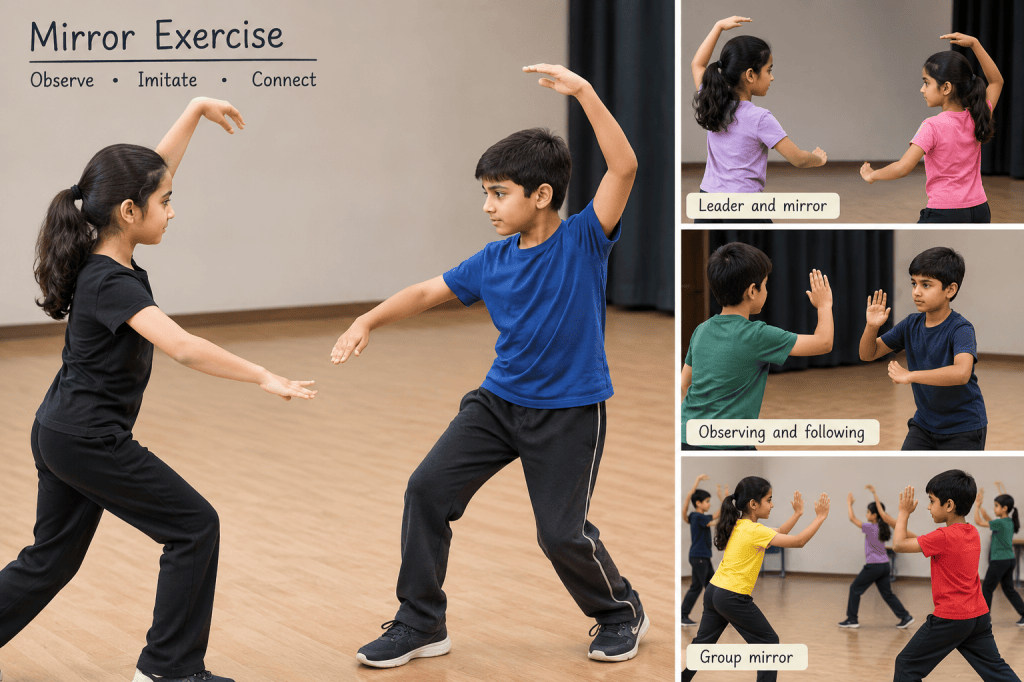
Steps to conduct this game:
- Divide the children into pairs.
- Ask each pair to stand facing one another.
- One participant becomes the leader, and the other becomes the mirror.
- The leader begins with slow, controlled movements of the hands, head, shoulders, torso, or entire body.
- The mirror follows these movements as though looking at their reflection.
- The leader should gradually introduce different movements while maintaining a steady pace.
- After a couple of rounds, change roles.
- At an advanced stage, ask the pair to move simultaneously without deciding who is leading. The objective is to make the movement appear as if it is produced by a single body.
8. Gibberish
As the name suggests, Gibberish is an improvisational theatre game in which nonsensical words are used to communicate. Although the words have no literal meaning, the actors must communicate ideas, emotions, relationships, and intentions through voice, tone, facial expression, gesture, and body language.
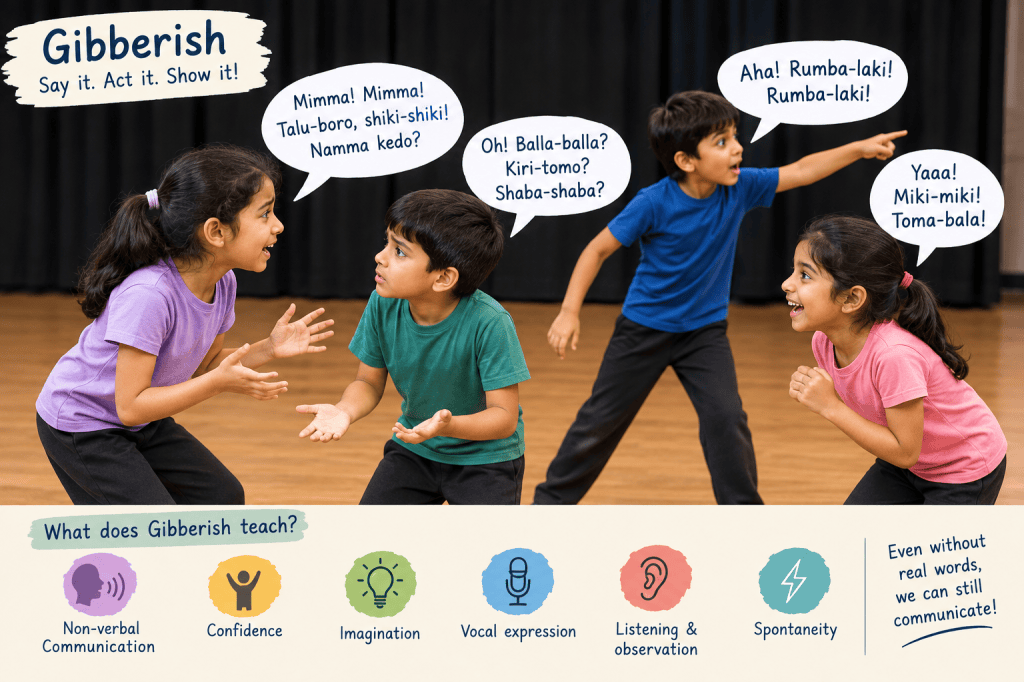
Steps to conduct this game:
- The children should work in pairs or small groups.
- Give them a simple situation, such as a customer and a shopkeeper, two friends having an argument, a teacher and a student, or a doctor and a patient.
- The participants speak only in invented sounds whose meanings are undefined.
- They can make the situation understandable through their actions, expressions, gestures, and vocal qualities.
- After a few minutes, ask the audience what they think was happening.
- Refer to the bottom of the image about the significance of this game.
9. Yes! Let’s
Yes, Let’s! is a simple and highly effective improvisation game that teaches children to accept ideas, respond spontaneously, and collaboratively create scenes in response to the situation. It is particularly useful for developing confidence, imagination, listening, and teamwork.
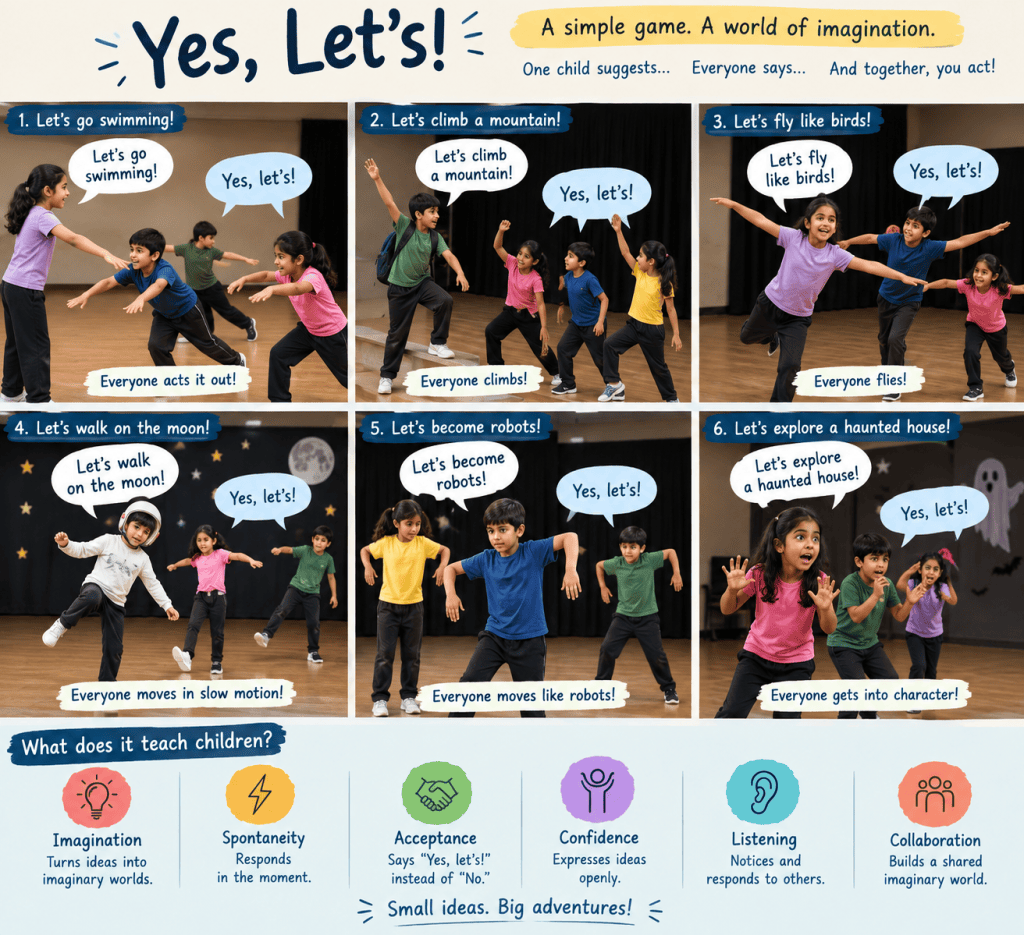
- Steps to Conduct this game:
- Ask the children to stand or sit in a circle.
- One child proposes an imaginary activity by saying, “Let’s go swimming!”
- Everyone responds enthusiastically, “Yes, let’s!”
- Everyone then acts out swimming using their bodies and imagination.
- After the completion, another child proposes a new activity:
- “Let’s climb a mountain!”
- The group responds:
- “Yes, let’s!”
- Everyone immediately begins acting as though they are climbing a mountain.
- The activity continues with increasingly imaginative suggestions.
10. Tableau / Frozen Picture Theatre Game
Tableau, also called a Frozen Picture or Still Image, is a theatre game in which individuals or groups use their bodies, facial expressions, gestures, and spatial positions to create a motionless picture representing a person, situation, idea, or story. It allows to explore storytelling without words.
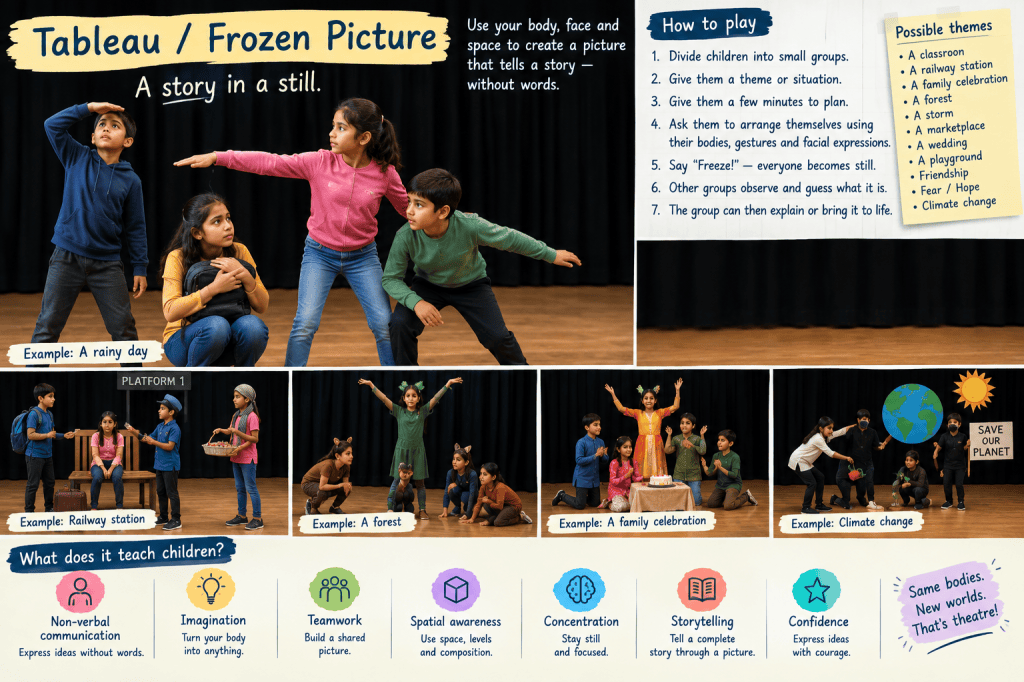
Steps to conduct this game:
- Divide the children into small groups.
- Give each group a theme or situation.
- Give them a few minutes to decide how they will represent it.
- They arrange themselves using their bodies, levels, gestures, and facial expressions.
- When the teacher says “Freeze!”, everyone becomes completely still.
- The other groups observe the frozen picture and try to interpret what it represents.
- The performing group can then explain its idea or bring the tableau to life.
- Refer to the bottom of the picture for its significance.
While some of the exercises overlap in terms of movement and direction, each enhances a specific skill set. If practiced seriously, these games would foster holistic growth in terms of physical and mental well-being. These games incorporate practice-based learning to engage the different senses. Now let’s discuss how these theatre games promote attentive listening, develop confidence, and foster imagination.
1. Promoting Attentive Listening
Theatre games require children to remain alert to others’ words, movements, gestures, sounds, and reactions so they can respond appropriately. In games such as Walking in Space, Mirror Exercise, Zip-Zap-Zop, and Yes, Let’s!, a child cannot participate meaningfully without paying attention to what others are doing. They first have to observe the details, then practice them. For instance, in Mirror Exercise, one child must carefully observe the partner’s movements and reproduce them. Similarly, in Yes, Let’s!, children must listen to a suggestion before responding collectively. Such activities cultivate active listening, concentration, observation, and responsiveness. Children gradually understand that theatrical communication depends not only on speaking but also on listening and responding.
2. Developing Confidence
Theatre games engage the children in different roles, including leadership skills. It offers them a conducive space to enact their roles without the fear of judgment. For instance, in a mirror exercise, one plays the role of the leader, whereas the other follows, until the roles are reversed. Gibberish also removes the fear of using the ‘wrong’ words because the language itself is invented. Similarly, Tableau allows children to communicate through physical expression without speaking. Repeated participation helps children become more comfortable with public expression, creative risk-taking, decision-making, and performing before peers. These exercises help children improvise in response to the situation.
3. Fostering Imagination
Theatre games encourage children to move beyond the literal and transform ordinary spaces, objects, movements, and sounds into imaginary situations. As elucidated above, some games require a participant to imagine them in a space. For instance, ‘passing the imaginary ball and Yes, Let’s!’ is particularly effective because a simple suggestion, such as “Let’s fly to the moon,” can immediately become a collective imaginary experience where the scene needs to be enacted individually or within a group. Tableau also enables them to create visual representations of people, places, and abstract ideas. Through such activities, children learn to imagine possibilities, invent characters, and construct stories by transforming their bodies into objects.
The above exercises remind me of ‘theatre of roots,’ a movement active in Indian theatre during the 1970s, which places greater emphasis on physical vocabulary. These skills do not work in isolation. Instead, they are intertwined and enrich one another. For instance:
Attentive Listening → Understanding other’s views and opinions → Respond creatively → Imagination → Expression → Confidence
Thus, theatre games function not merely as recreational activities but as experiential pedagogical practices that integrate listening, self-expression, collaboration, and creative thinking. When integrated into classroom teaching, these games would increase attention while promoting collaborative learning. After these exercises, students can also be assigned to enact a scene to enhance their comprehension and reception of the playtexts.
If you want to engage your child in such a creative space for overall growth near you, this link will guide you: https://discover.lyfskills.com/kids-activities-near-me
Let me know if you have any questions or any suggestions related to this post.
©Shashank
Disclaimer: ChatGPT has been used to generate images related to the theatre games.
 Pragmatic's Personas