
Theatre games serve the same purpose as other games. It fosters focus, enhance physical movement and prompts spontaneous movements needed during performance.
This post is another attempt to integrate performative aspects of drama into the curriculum. I request that readers not confuse it with actors’ training, which is a set of exercises that require extensive practice over a longer period. For instance, Natyashastra suggests extensive training techniques for classical dance and drama. K.N. Pannikar, a theatre-of-roots practitioner from Kerala, integrates Koodiyattam and Mohiniyattam, along with Kalaripayattu (an ancient Indian martial art), to train his actors for performance. However, since the classroom learning should be inclusive, we are going to discuss a set of exercises that can be practised by everyone within a liminal space, without the aid of experts. They are playful, easy activities designed to enhance concentration, coordination, movement, flow, and voice while fostering teamwork. These exercises can serve as a preliminary activity to encourage students to enact a drama.
In this post, I have explored five basic warm-up exercises for beginners to help you prepare for any performance, both mentally and physically. In the subsequent one, I’ll delve deeper. Let’s try these exercises one by one. I request that you visualise them or introduce them into your classroom learning.
Disclaimer: I haven’t invented these exercises. I am trying to elucidate them to integrate them into the drama pedagogy.
1. Zip Zap Zop
In this game, a group stands in a circle facing inwards and shouts “zip” and claps while pointing at a random member, who must respond instantly. That member has to transfer this energy to the next person by shouting “zap,” and the next person should transfer it by shouting “zop.” Thus, this fast-paced classic improv and theatre warm-up game builds focus, eye contact, and teamwork. Visit this link to check how it is played.
Method
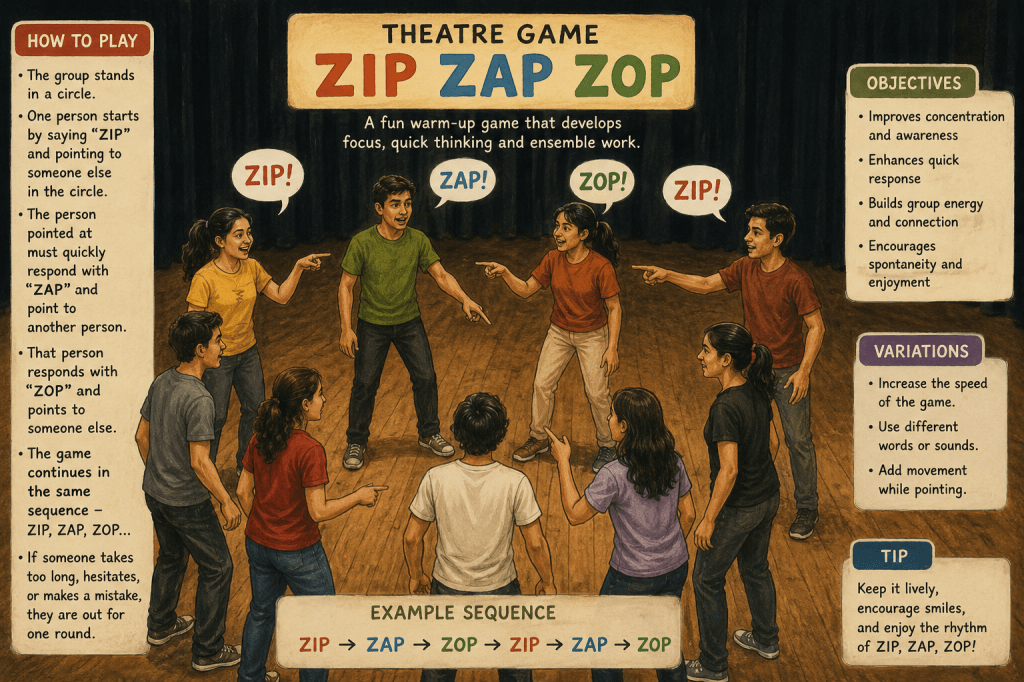
During the performance, it facilitates the smooth transition of dialogue and actions from one actor to another. This game is the basic unit for performative learning.
2. Name and Gesture
If you’re able to enact your name, you can also understand the meaning of different words and how to enact them. Instructors can ask students to do this during their introductions.
3. Pass the Clap
This game looks like a part of Zip Zap Zop only. However, it can be improvised here without uttering any sound. Let the gestures communicate. Since theatre is also about action, this exercise will help build a response to it.
4. Passing ‘Imaginary’ Energy Ball
We have all played this game during cricket sessions, but with a physical ball that has a definite size, weight and shape. But what if the ball’s structure, nature and weight are unknown? How would you perceive it? You’ll see that the mind adjusts accordingly.
Method
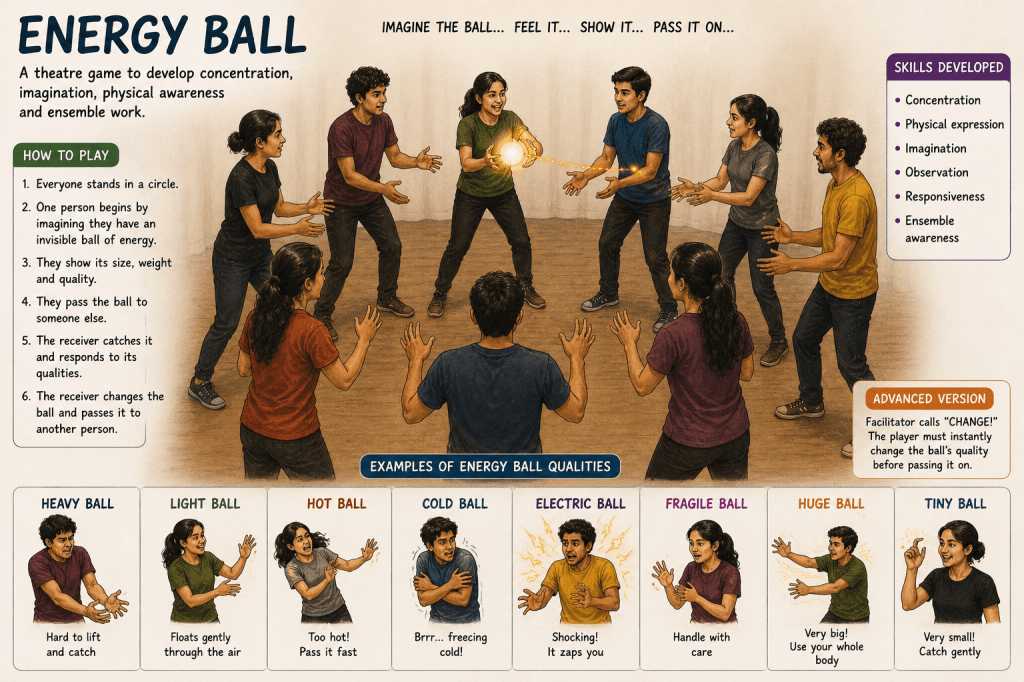
You can imagine how such games can boost an individual’s cognitive abilities. This game is particularly helpful when there is a strong emphasis on physical vocabulary.
5. Shake Down
This game develops coordination between your gestures and voice. In performance, action should correspond to the dialogue you speak without a lag.
Method: You can count from 10 to 1 in reverse and vigorously shake a part of your body, such as your hands or legs. For instance, start with the left hand, then the right, then do it with the legs. At the end, shake the whole body vigorously, then suddenly stop and stand still. Move from motion to freeze and freeze to motion. Let the body feel the transition. You can visit this link for the visuals. To maximise its impact, you can repeat a sentence instead of the numerals that are troubling you. For instance, shake off my worries and nervousness. This sudden transition from intense movement to stillness is particularly useful for developing control, concentration, and stage awareness.
You can feel how these exercises promote mental and physical awareness, concentration and coordination. Even if not for the theatre, they can be practised as a game in one’s free time. In the next post, we’ll explore more theatre games.
Let me know your inputs on the above games!
©Shashank


LikeLike