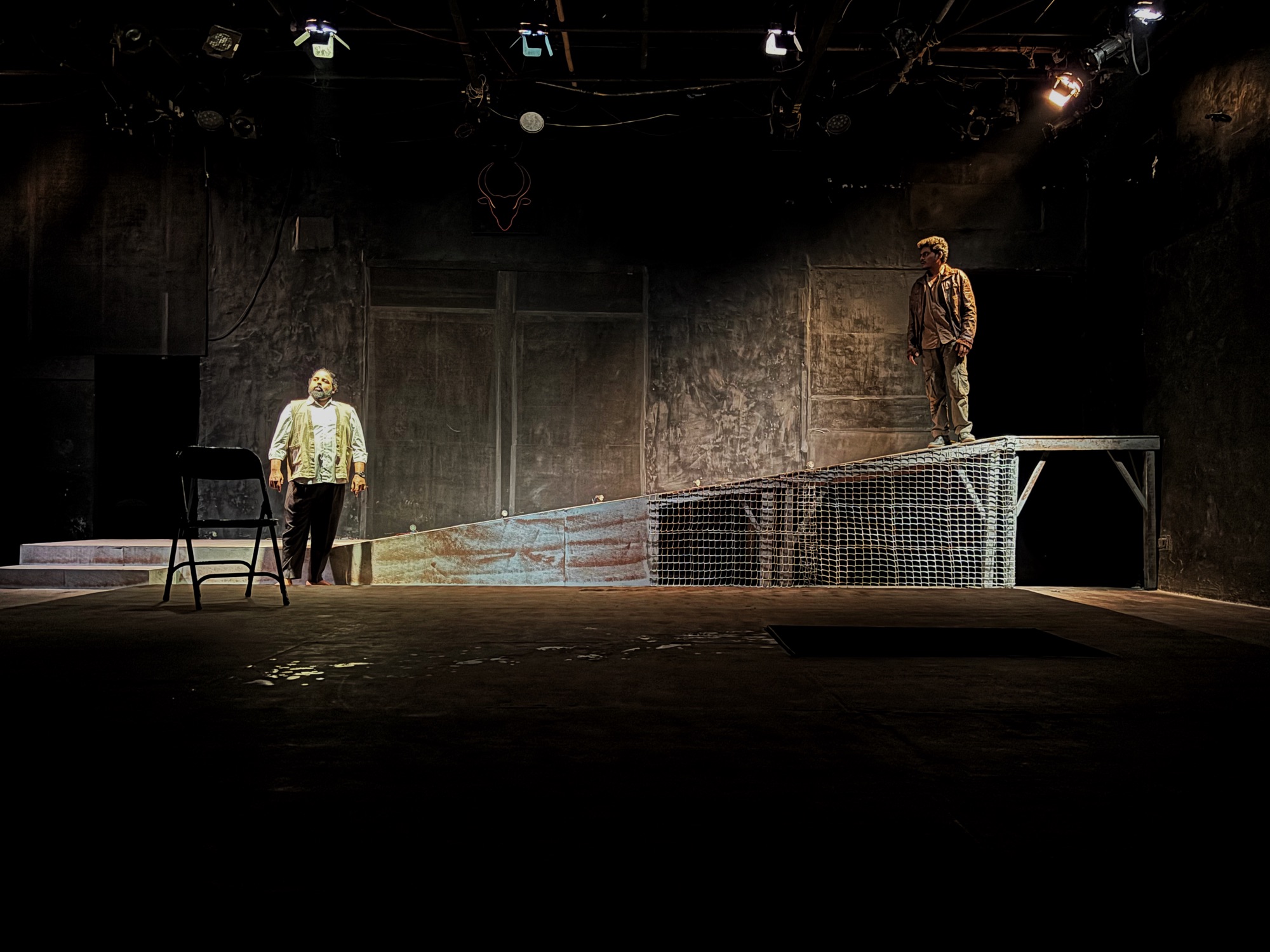

Watching Shabdangal while sitting in vicinity to the actors in Bahumukh auditorium of NSD, I realised that the distance and the barrier in the proscenium theatre does offer hinderance in rasanubhuti.
I had the opportunity to watch Shabdangal in the second edition of Bharat Rang Mahaotsav (2026) while returning from a conference. The train to Roorkee was scheduled to start at night, whereas I reached Delhi in the evening. Hence, to make the most of the time, I booked a ticket to Shabdangal. Based on my previous experience watching a play at the Bahumukh auditorium of NSD, I knew it would delight me to the fullest.
A Note on Bahumukh Auditorium: It’s a small, intimate, and experimental black-box-style studio theatre with the audience seated on two sides on stair-type benches. The maximum capacity is around 100 people. The set and lighting can be modified to meet the requirements of the play. A control console for light and sound is near the stage entrance. Also, the intimacy offered by the Bahumukh auditorium is such that I would want to watch a play there again and again.
Title: Shabdangal
Adaptation. In Hindi of the Malayalam novel by Vaikom Muhammad Basheer
Director: Salma Dandin
Theatre Group: Graduate Performance Wing of NSD
Auditorium: Bahumukh (NSD)
Running Time: 1 hr and 30 minutes (approx)
Date Enacted: February 9, 2026.
Genre: Tragedy, Social Satire
I wasn’t acquainted with Basheer’s novel when I watched the play, and not even when I wrote this review. Hence, my review would be based solely on my experience of watching the play.
Shabdangal is a memory play in which a soldier unveils to a writer his experiences of all the wars he has been part of and his evil deeds, and the writer listens to him and offers his critical opinions. The term Shabdangal means ‘voices.’ The soldier is agitated by the multiple voices occupying his mind; he wishes to narrate his story to someone, in this case, a writer, to free his mind. The writer intervenes, questioning his story to delve deeper to further reveal the dark secrets of his life. The series of events narrated by the soldier is presented by a group of actors on the stage. Through the personal experiences of the soldier, the play questions the futility of war, giving rise to famine, diseases, making people orphans, and leading people to turn to prostitution, including homosexuality, to satiate their desires.
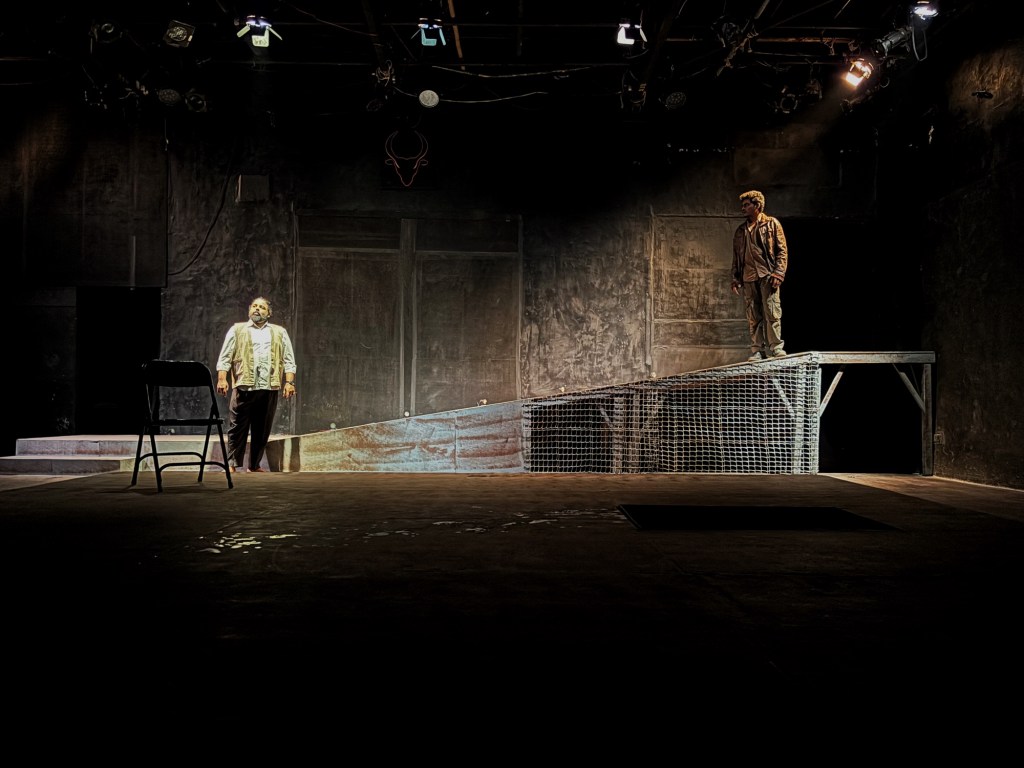
The set is meticulously designed with a wooden floor raised around 6-7 inches from the ground. A square-shaped groove is filled with water, and a soldier is shown to have an aversion to it, mistaking it for blood. A ramp, at the backside of the stage, as shown in the picture, marks the entry/exit of characters. The placement of spotlights illuminates the specific areas of the stage as required. The light also changes color depending on the emotion a scene conveys. Occasional folk music and dance offer greater clarity about the play’s background.
The whole play is energetic and packed with action, where the characters offer a realistic portrait of the soldier’s dream. There are moments of heightened tension or emotion that can be felt since the audience is seated close to the actors. At one moment, the actor also draws some of the audience onto the stage to dance with them. The audience also becomes part of the conversation, as the actors look into their eyes to elicit responses. Consequently, the audience also becomes part of the play.
Hence, I would suggest you watch a performance in Bahumukh at least once for a unique experience, and if it’s Shabdangal, you should definitely make time in your busy schedule.
Visit the following links to view a couple of clips from the performance to get ideas about the stage design and the play’s intensity.
©Shashank

