
Shakespeare was as much a part of other countries as of England. His popularity can be guessed from the fact that there were more than 500 adaptations of his plays in India alone.
Naya Theatre, curated by Habib Tanvir in 1959, aimed to reverse the colonial trajectory of Indian theatre while connecting it to India’s culture and tradition. Tanvir is known mainly for two interventions in Indian Theatre. The first was that he introduced local artists in his performance, and the second was that he broke away from the proscenium theatre into diverse spaces. He adopted the folk form Nacha of Chhattisgarh, in which music and songs play a complementary role in the performance. Hence, he named his theatre ‘Naya’ or ‘New.’ Though Tanvir is no more, his performance troupe has kept him alive forever. Isn’t it true that an artist never dies!
Again, it was the SPIC MACAY club at my institute that invited the Naya Theatre group to perform. Before the play, we also had two days of a workshop. I had the opportunity to interact with Ramchandra ji, the director of Naya Theatre, and witnessed their training techniques and some scenes from Tanvir’s iconic Charandas Chor. The B-tech students of IIT Roorkee have also aped some of the troupe’s scenes during the workshop session. I have an ardent desire to watch the full play on the stage, but this time, A Midsummer Night’s Dream was on their list.
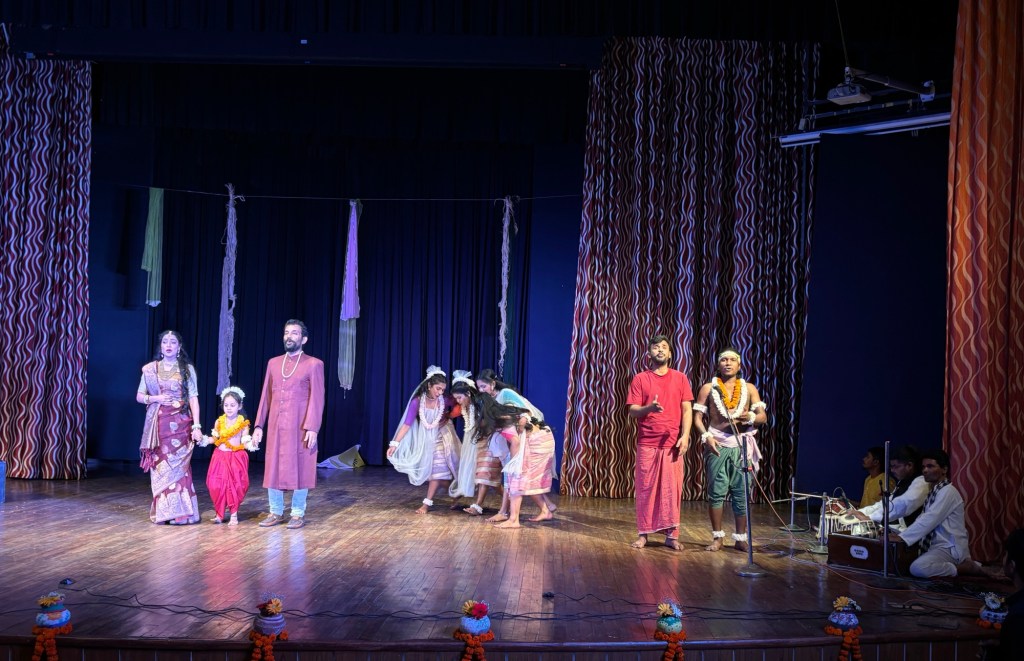
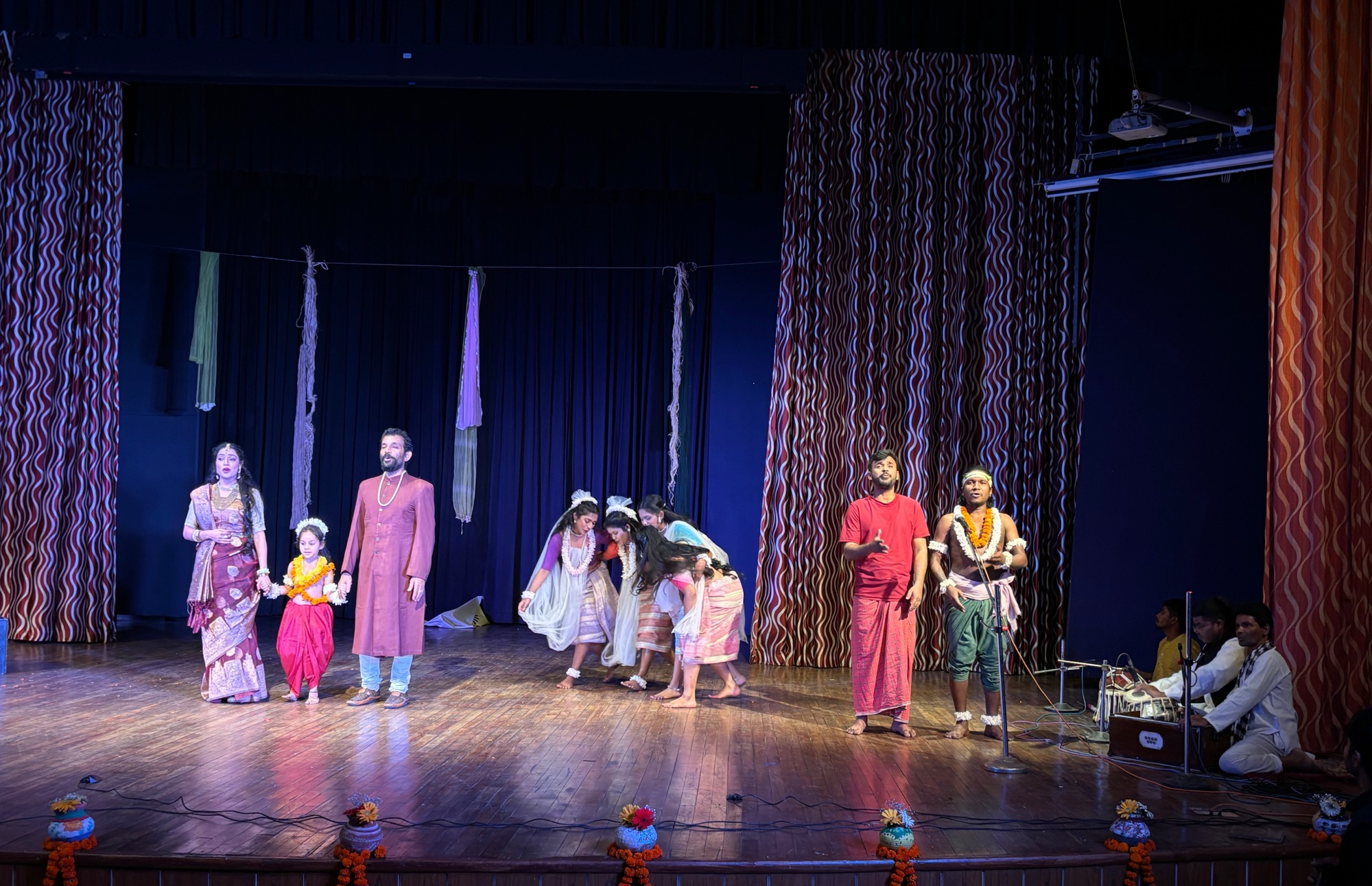
Title: A Midsummer Night’s Dream (originally by William Shakespeare)
Theatre: MAC Auditorium, IIT Roorkee
Theatre group: Naya Theatre (translated and adapted by them)
Running time: 1 hour 40 minutes (approx)
Director: Ramchandra Ji
Staged on: 31st March 2026
It was only the second time I had the opportunity to watch any Shakespearean adaptation. Before this, I watched a production of Shakespeare’s Hamlet at LTG, Delhi. However, Naya Theatre’s outlook is innovative and musical, resembling a folk play. At crucial moments, two performers provide commentary in poetry instead of prose to heighten the sense of reception. Additionally, the poetry parts are in the Chattisgarhi dialect to provide a flavor of natural speech. It is accompanied by harmonium and tabla to add a layer to the performance. Interestingly, music aligns with their movements. One of the remarkable aspects of the play is the shift in language level, as in Shakespeare, which is also upheld in Naya Theatre’s adaptation. Shakespeare used inferior English for clowns and fools, whereas standard English for royal characters. In the same way, the performance is primarily in Hindi, with occasional Chattisgarhi dialogues. The costumes the characters wore were also appropriate to the setting and their socio-cultural milieu. The adaptation is adequate for the audience to understand the play. However, I feel the performance made more sense to those who already knew the plot of the original play.
As I always used to say, a play is a dynamic entity. It changes over time, with age, and across audiences. The adaptation of A Midsummer Night’s Dream by Naya Theatre is remarkable for several reasons. The play isn’t indigenous in theme and is staged in a proscenium theatre, neither of which aligns with Tanvir’s vision. But when you stick to the principles, the innovation ceases. For instance, due to the extensive and rigid structure of the Natyashastra, Sanskrit plays fell out of fashion, and the theatre group polarised toward Western techniques. Despite Naya Theatre’s adaptation has been indigenized to a great extent in terms of language, costume, and setting. My only concern was the character’s name, which was kept intact, which I felt hindered the performance’s reception in the Indian context. However, while adapting, care should be taken to retain some of the original play’s flavor.
What are your opinions? Do let me know in the comment box. Additionally, interested ones can view a couple of recordings of the workshop and performance by clicking here.
©Shashank
Disclaimer: All content and images on this blog are protected by copyright and are the intellectual property of the blog owner, unless otherwise stated. Unauthorized use, reproduction, or distribution of any text, images, or other materials without permission is strictly prohibited. If you wish to share or reference any part of this blog, provide proper credit and include a link back to the original source.
 Pragmatic's Personas