
The discipline of drama analysis has become regarded as a literary discipline that risks overlooking the performative aspects and the material, scenic context of the drama.
– Kallenbach and Kuhlmann
If I say that any drama is more read than performed in India, would you believe it? You don’t need to believe me. I would advise taking this exercise. Reflect for a while- How many plays have you read till now? How many plays have you watched in theatres? The fact that not every city or town has an active theatre society also contributes to the same. In academia, the teaching and learning of drama is largely theoretical. It often involves analysing the play’s themes critically, with little emphasis on the performative aspect. It is pertinent to bridge the gap between the theoretical and practical aspects of drama.
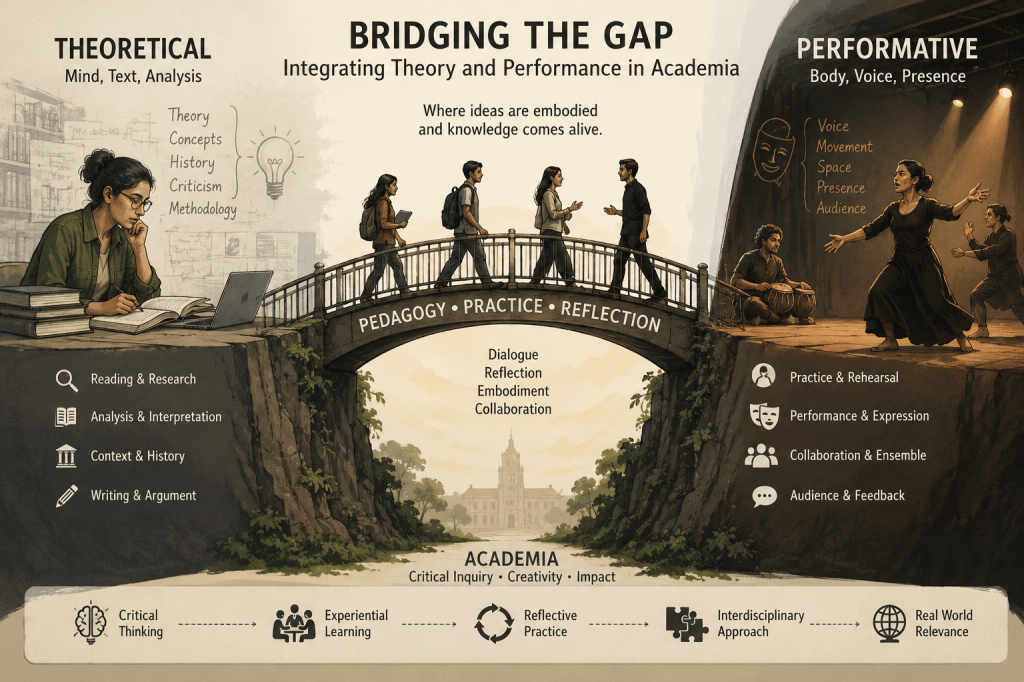
Let’s put aside the debate for a while about whether a drama is meant to be read or performed, and read it as the way it is performed. If you wanna discuss this topic further, get in touch with me personally. Meanwhile, let’s ponder reading a drama in terms of performance. I’ll list them in the points.
1. Try understanding the context of the drama first. The age in which it is set serves as a fine starting point. It’ll give you an idea about stagecraft employed on the stage.
2. Instead of taking a quick glance through the character’s list, try visualising their appearance and behaviour.
3. Stage directions should be read with utmost attention. Visualise it on the stage. Brainstorm the various ways in which it can be enacted on the stage. Since play is a dynamic entity, you should keep the contemporary audience and their tastes in mind. Character’s entrances and exits should be marked.
4. Pick up the non-verbal cues written alongside the character. Imagine how the characters would behave in real situations.
5. Since the contemporary theatre is largely controlled by light and sound, you should try viewing the play in this light. Visiting theatres will help you understand the light and sound design. It also conveys different moods.
6. Pay attention to scene and act shifts within a dramatic text.
7. Be innovative in your approach. Try figuring out how to portray scenes like fire and water on the stage.
8. Read the play not as divorced from the stage. Visualise it as if it is being performed on the stage.
9. Multiple readings may be required. Reading in terms of performance doesn’t mean that you shouldn’t analyse the text theoretically. Thematic analysis will help better understand the characters’ behaviour and the plot.
10. Familiarising with the theatrical space would help enhance the visual approach toward any play. You can read my post on the anatomy of the theatre to acquaint yourself.
Example:
Let’s go through the opening scene from Dattani’s play Thirty Days in September
The stage is divided into four acting areas. All the action moves without any set changes between scenes.
The first area has a comfortable chair and a simple table with magazines and a double seater. The chair is reserved for the counsellor whom we never see.
The second area, occupying the central portion of the stage, is the living room of Shanta and Mala’s home in a suburb of Delhi. The dominant feature is a large picture of Shri Krishna. The furniture is basic and minimal, almost as if this is just a point of transition rather than a room where the family would meet and receive people.
The third area is the pooja room which is perhaps behind a scrim so that it is visible only when required. The scrim will go up in the last scene as specified.
The fourth acting area is the most flexible, representing several locations—a party house, two restaurants, Deepak’s home. Since this area is more representational, it would suffice to have four cubes that could be configured by the actors before the required scene, in full view of the audience.
During Mala’s taped conversation, we see the back of a life-sized doll of a seven-year-old girl propped up on a chair. During the first conversation we only see the back of the head. With every subsequent taped conversation, we see more of the profile. We only see the doll’s full face after Deepak’s taped conversation. (p. 87)
Now imagine a stage divided into four parts, each visible to the audience except the Pooja room, which is protected by a scrim. The idea is to display a house. Arrange the props accordingly. Think of more ways this scene can be adjusted on the stage.
Also, if you have more views and suggestions for a better engagement with a dramatic text, feel free to share them with me!
©Shashank
References:
- Kallenbach, Ulla, and Annelis Kuhlmann. “Towards a Spectatorial Approach to Drama Analysis.” Nordic Theatre Studies, vol. 30, no. 2, 2018, pp. 22–39. doi:10.7146/nts.v30i2.112950.
- Dattani, Mahesh. “Thirty Days in a September.” Brief Candle. 2010.

