
The stage is not merely the meeting place of all the arts, but also the return of art to life.
-Oscar Wilde
Derived from the Greek word ‘theatron,’ theatre refers to a place of viewing. To understand the structure of such theatre, consider it a room where the fourth wall is removed, allowing the audience to see what happens inside. A proscenium theatre is divided into two sections: the stage (where the actors perform) and the house (where the audience sits). Let’s look at the stage first.
The way a director or performer views the stage isn’t the same as the way performers do. For the audience, the stage is a singular and fixed entity. For the performers, it’s divided into several sections, sometimes even decided by the position of the lights, which are also flexible in a modern stage. I welcome you all to the fourth episode of Crossfade, in which we’ll learn about a theatrical stage.
We’ll begin with the age-old division of the stage area into nine main sections- three upstage sections and three downstage sections.
Note: The stage section is marked according to the performers, not the audience. For instance, from the audience’s perspective, downstage is toward the rear of the stage. However, the correct convention is to mark it from the performer’s side.
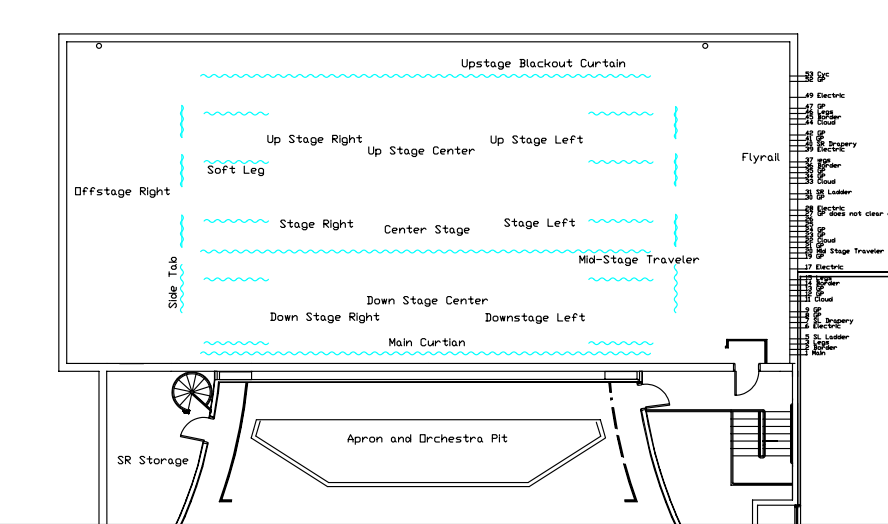
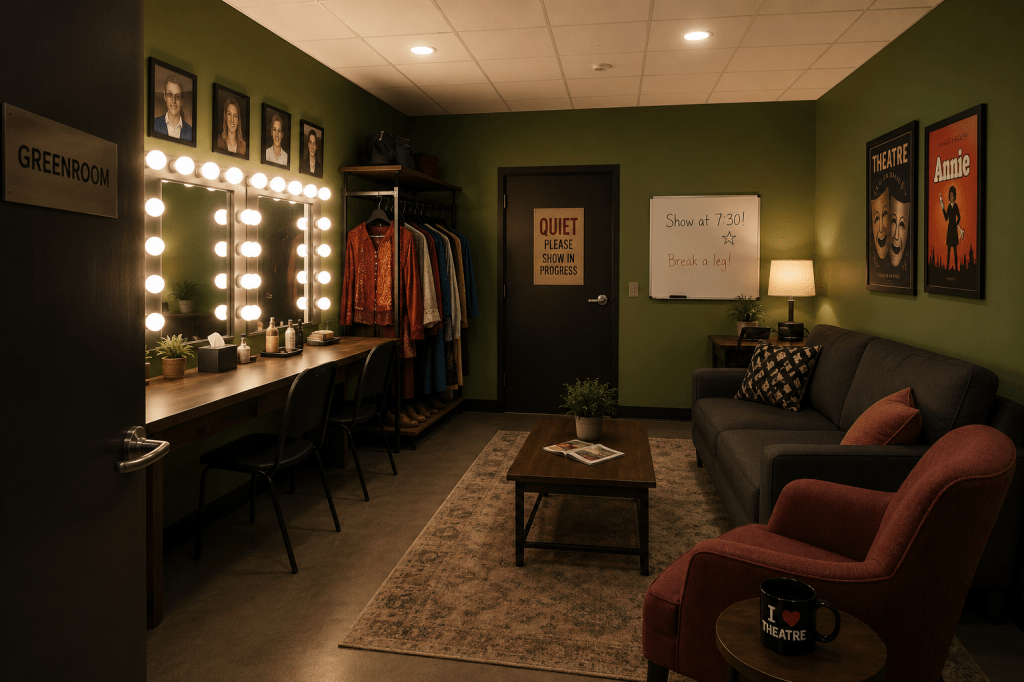
Offstage right and offstage left are also known as right and left wings. The wings don’t have doors, but the entire area is vacant, with curtains suspended to provide multiple entry and exit points. An apron is the semicircular area after the downstage. The action doesn’t happen here since it’s considered a foul. The green room is the area behind the stage where performers get ready, change costumes, and wait for their roles. If their role is the immediate next, they wait in the wings to make a swift entry.
In modern theatres, except for a few spotlights, most are movable and can be adjusted to meet the requirements of the performance. The whole bracket on which the lights are mounted comes down, allowing technicians to adjust, replace, and modify the lights to illuminate different sections of the stage and the performer. The lights are also classified as house lights and stage lights. House lights go dim or off during any performance. In modern theatre, these lights guide the performers. Since theatre has been digitalised to enhance the audience’s sensory perception, there is also a screen at the rear of the stage. Some plays also require projection and mapping. The technology for the same has also been enabled. Some plays also require surtitling, especially when performed in a different language. The screen, displaying a surtitle, is placed at the corner of the stage.
Now, let’s know about the control console:
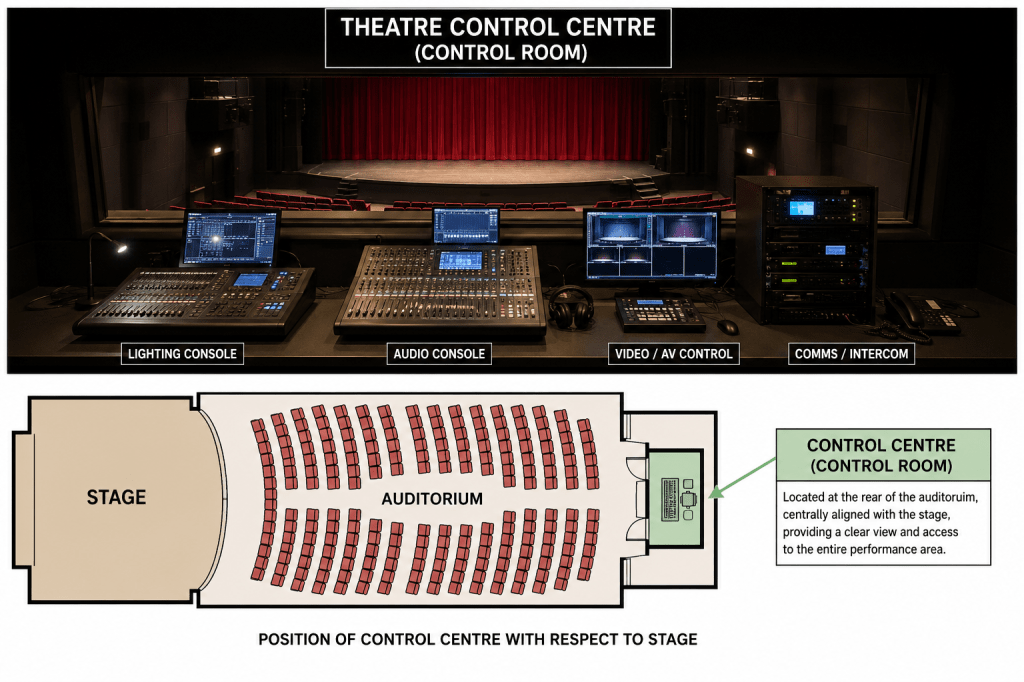
The control room (window or box-like structure) is situated at the rear part of the stage at an elevated level. In some of the theatres, the control room is open. For instance, at the Abhimanch auditorium of NSD. Some theatres have a separate entry or exit to the control centre, while others have it through the house. This section provides a complete view of the stage and is usually brimming with wires, where even Kirchhoff’s law would fail.
This is the basic outline of a modern-day theatre. There are many terminologies associated with it, which you can find here. Now, let’s have a look at how to utilise the various stage areas while composing any play.
- A character enters from the right wing and stands at downstage right. Lights illuminates him.
- A group of people, moving swiftly, enters from offstage right and exits into offstage left. This process continues for a while.
- Four characters enter the stage. One stands at downstage centre, whereas the other three occupy the rear sections of the stage. Overhead projection illuminates them.
The usage of the stage area has evolved over time. The modern stage incorporates several technologies to enhance the audience’s reception. You can also explore several ways to utilise the stage.
©Shashank
Disclaimer: All content and images on this blog are protected by copyright and are the intellectual property of the blog owner, unless otherwise stated. Unauthorised use, reproduction, or distribution of any text, images, or other materials without permission is strictly prohibited. If you wish to share or reference any part of this blog, provide proper credit and include a link back to the original source.


One thought on “Crossfade- Episode 4: Anatomy of Theatre”